

There was darkness. There was hope. Somewhere around 36,000 feet above the ground between Seattle and Fairbanks the two were wrapping themselves together in my soul, arriving through drop-D tuning. As I sat in my seat, hitting rewind for the near 100th time on my CD player, something within me was stirring.
Marine Corps boot camp fresh in my memory, a few days home on the horizon and the soundtrack to a movie I’d yet to see — Singles — in my ears, I gazed out the window and felt that maybe, finally, a shift was coming. Skipping past Mudhoney, past Mother Love Bone, Alice in Chains’ “Would?” was the object of so many touches to my CD player and in that deeply dark sound, I was finding hope.
Fairbanks, home, was an absolute whirlwind. I’d left abruptly without notice and needed to spend some time explaining things to folks — not least of which was the 50-pound weight loss I’d undergone in just three months, making me nearly unrecognizable to most. Patrick and I had stopped into the Market Basket in North Pole, picking up something for Mom. Tina, our dear friend from high school, happened to walk by. I called her name, she didn’t hear, so I spoke louder. She turned, recognizing Patrick but looking at me without recognition, her eyes narrowing as she tried to place me and then going wide as the puzzle piece snapped into place.
“Maurice?!” her voice escaped, not confident in her question. During our sophomore year Tina had decided that I looked more like a Maurice than a Benjamin — so sayeth the shepherd, so sayeth the flock. I was Maurice to my friends from that moment.
“Yep,” I replied as a wave of confidence filled me. I’d always had a thing for Tina and standing there proudly in my new body, I was brimming with optimism.
We hugged, exchanged a few words and then went our separate ways. Mom’s last-minute assignment of picking up some items at the grocery store was a mere diversion to my true mission some 13 miles down the road in Fairbanks.
“So where to next?” Patrick asked as we jumped into the car.
“Pizza Plus, see Dawn and Rick and then Fred Meyer, man — I’ve got to get that Alice in Chains album,” I replied.
One thing worth noting: Patrick is about as close to me as any one person can possibly get — we’re Irish twins, him born in January of ‘75, me February of ‘74. We shared almost everything growing up and neither of us was ready to fall asleep until we’d chatted for at least a few minutes, each of us in our bed, about the day’s events, why we were mad at the other, or whatever needed to be said. We shared a room every day of our lives until I left for the Marine Corps. All these years later, we still spend most Saturday mornings up in the wee hours before our collective households are awake, chitchatting about life, music, and whatever else comes our way.
Grunge had already done the necessary work of displacing hair metal bands by that time and thank God. I’m not going to sit here and say that everything from that era was horrible — there were a lot of amazing songs released. But. It would be a massive stretch to suggest that any of those bands were populated by decent human beings. Nothing turns my heart a darker color than thinking of the recent resurgence of bands like Mötley Crüe, Poison, and Skid Row.
We made the stop at The Plus, spent some time there before we finally headed down College and pulled into Fred Meyer — away from the main store and the separate music shop. Immediately grabbing Dirt, I took a few minutes to see what else was available. This was 1993 and release after release was absolutely amazing — the biggest issue at the time was the lack of funds to get everything I wanted. I grabbed Dirt, Nevermind and Everybody Else Is Doing It, So Why Can’t We? All I wanted to hear for the long car ride home was Dirt.
But it wasn’t to be. After much discussion we settled on Nevermind and I promptly got swept up in the tsunami that was Nirvana. Already a fan through a friend’s cassette a few years earlier, catching this wave wasn’t much of a shift for me. I was a fan and for a spell, the only thing I cared about was this band, Alice in Chains temporarily set aside for the moment. My leave came to an end and I was on a plane, heading for Camp Pendleton and life as a newly minted United States Marine.
I must have looked like an absolute lost lamb wandering around the streets of Oceanside, taking everything in, not enough hours in the day to absorb everything I was trying to make a part of me. The music was alive in ways I’d never experienced. We had our share of outdoor concerts growing up but when summer is limited to a few months a year with the rest of the year in some state of freeze, there tend not to be many opportunities — let alone an amphitheater with an ocean backdrop. Music to me was something experienced in the dark of your room, on a long bus ride, or in the seat of your car, not with ten thousand of your closest friends all sharing the same space, all moving with the same rhythm. But none of that prepared me for Lollapalooza 1993.
I had dreamed about this festival for years. Perry Farrell of Jane’s Addiction threw the first one together in 1991, envisioned as a farewell tour for his band. But it picked up steam and just kept going — I hoped it lasted long enough for me to make one. A copy of Rolling Stone spread open across the steering wheel of my 1984 Nissan pickup, I fantasized about finally getting out of Alaska and being somewhere this show was playing. I’d already missed Ministry, I’d already missed Nine Inch Nails — I didn’t want to miss any others, ever again. So when my Marine buddy Richard asked me if I wanted to go, it was a no-brainer. I coughed up the last bit of money I had, bought a ticket and waited. August 7 finally rolled around and four of us loaded up on an Amtrak in Oceanside, destined for Los Angeles — or more specifically the Santa Fe Dam Recreation Area in Irwindale.
If you’ve not looked at the lineup for the show, and why would you have if you weren’t there, the lineup was simply out of this world. The second stage was packed with Rage Against the Machine, Tool, Front 242 and Babes in Toyland. And that was the second stage. Main stage? Arrested Development, Fishbone, Dinosaur Jr., Primus, and Alice in Chains.
It was absolutely sweltering that day and the biggest trick was avoiding sunburn and dehydration for the day-long event. There was a moment halfway through the day I felt almost as though I had an out-of-body experience — I genuinely could not believe what I was seeing, what I was hearing, what I was feeling. The music, the energy of thousands of fans crushed into the tight space. I’ve often wondered what it felt like to have seen Led Zeppelin or the Rolling Stones when they were still young, still unknown — my story is seeing Rage Against the Machine and Tool when they were still mostly unknown, playing second stage at a traveling music festival.
The sun finally began to set and with it the temperature began edging down ever so slightly. Primus erupted onto the stage and Les Claypool dazzled the crowd for nearly an hour with his theatrical stage antics and masterful bass lines. As much as I loved the show and am a huge Primus fan, I was here for Alice in Chains, the final act. The heat, the lack of water, the sunburn — all of it led to this moment.
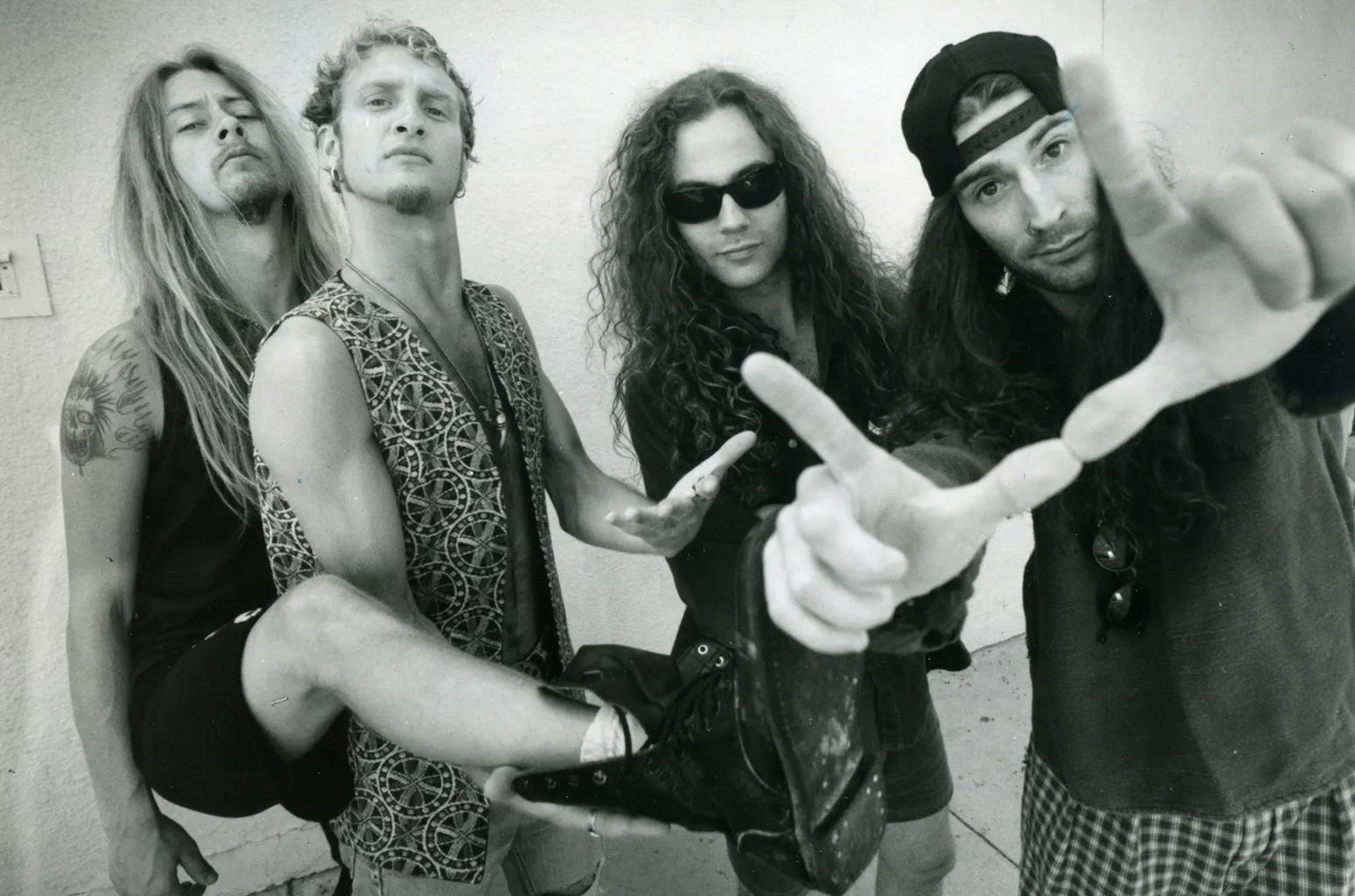
A curtain of chains descended upon the stage and the dark, foreboding bassline of “Angry Chair” erupted from the speakers. It’s no understatement to say the crowd erupted into bedlam as the band exploded into their set, Layne in his signature dark sunglasses — if only we’d known — and for twelve songs, I was swept up in a moment that still leaves me slightly taken aback to this day. People were climbing the chain net and diving into the crowd, mosh pits opened and closed across the throng of people and the music drove a generation.
The ride home on the train was a blur, my mind too overwhelmed, too sensory overloaded to properly place what I’d just seen — so I just stared out the window into the passing darkness, the occasional lights of an approaching town the only indication movement was happening. If someone had looked close, I would have had to explain away a few tears — not tears of sorrow, not even tears of joy, tears of release. Tears that come whether you want them to or not, when you’re so overwhelmed and the energy has to go somewhere.
Few things are certain in this world. One certainty is that life will continue moving forward. I moved around Camp Pendleton offices, landing at the Division Information shop. I moved homes, coming to rest in an apartment complex just outside the back gate. A terrible decision on a marriage left me struggling to figure out how to pay rent and thus a revolving cast of characters — or perhaps, more precisely, a revolving cast of wallets — took up residence in that Oceanside apartment. At different times I shared a room, slept on the couch, slept on the floor — whatever it took to never move back to the barracks.
Very few nights found me alone and on those chance occasions where everyone else had something better to do, I would drift off to my headphones. I would upgrade to a stereo system courtesy of one of those rent-to-own places, trading my headphones for club speakers. Richard was gone, Jason was gone, Gary was gone, Tim was gone. I slipped Dirt into the CD player, turned it up as loud as I could without a visit from the property manager, stretched out on my couch and closed my eyes.
My dad was a career military man, having done 20 years in the Army. When he finally retired, he immediately went to work as a civilian doing the exact same thing he’d done in the military — running mess halls. Reagan came along, my dad voted for him, both times, because military votes Republican. Reaganomics set about restructuring the federal workforce, one part of an economic policy that worked to increase the gap between the poor and the rich. Alongside the cocaine, decadence, and the highest highs for the wealthy, stagnation, real wage loss and economic downturn was the consequence for those on the lower economic scale. This is where the hollowing out of the middle class began in earnest and in our home some thirty miles outside of Fairbanks, we felt it.
Out of a job with six mouths to feed, a mortgage and the ever-escalating expenses of living in an environment that made everything harder, my dad finally landed work handing out basketballs at the base gym. I was too young at the time to understand what was going on, but some rule about laid-off federal workers gave him rehire rights for anything that came along on the federal side — so he handed out basketballs and wiped down weights at the base gym.
By the time I was alone in my Oceanside apartment, Clinton was in office. Maybe it was him as president, maybe it was this exact moment in my life — separation from the Marine Corps just down the road, my life about to get going — or something else entirely still unknown, but I felt a shift. The opening chaos of “Rain When I Die” filled the darkened room, the droning harmony of Cantrell and Staley giving it voice as Cantrell’s guitar wah-wahed through the opening. Nirvana may have been the generational lightning rod, Soundgarden may have had the voice in Cornell, but no one did dark harmony like the combination of Staley and Cantrell. Locked in, their voices wrapping around each other as they sang “She won’t let me hide / She don’t want me to cry,” a thought running counter to the music was beginning to take shape inside me. Those lyrics operate on three levels simultaneously: the drug, the witness, death itself. Staley was already living inside the album he was making. And somewhere amidst all of that, I felt like everything was going to be okay.
And for just a moment, it was.
Walking down Washington Street in Sonora, my 12-year-old nephew in tow on loan from his Wyoming family, we turned up the stairs into the venue, Black Bomb. There was a band playing tonight that I was keen to see — Aaron had clued me in, they had talent. Added bonus? Their guitarist, Cash, was the son of an old Army and Forest Service friend, Shawn. I hadn’t seen Shawn in a spell, so the chance to catch up was a nice addition to seeing the band. Wicked Ambition blistered through their set. Aaron was right. For being so young — the bassist still in high school — these kids held promise. Through no fault of the band, it wasn’t their originals that stopped me cold. It was their cover of Alice in Chains’ “Rooster” that transported me back to that couch in Oceanside, and a feeling of heartbreak washed over me.
Without ever directly expressing it, grunge broadly, Alice in Chains specifically, came loaded with promise and hope. They gave voice to darkness and forced a generation to sit with that darkness, own it. Implied in the albums they made — if you can sit with this, you can get through everything. But the promise fell apart. Kurt committed suicide in 1994, Alice in Chains played their last show in 1996, Layne found dead in his Seattle apartment in 2002. Pop punk exploded onto the scene as the whole culture decided it couldn’t look into the mirror grunge had put in front of them. Alice in Chains asked us to look deeper. Collectively, we blinked.
Some of us didn’t.
Sitting in front of my records, I pull Dirt from the shelf, dust off the record and move the stylus to the grooves. The couch in my house is eerily similar to the one I had in Oceanside — that one black, this one brown. Waves of emotion wash over me as a sense of betrayal rises. But that’s not right. All that hope I felt hearing this record for the first time — that wasn’t naivety. Those bands, those records, they earned it. Our culture just failed to deliver. But something deeper begans to take shape as I saw my 20-year-old self stretched out on that couch — that album gave me hope, gave me the armor to face the space between then and now. You’re going to have moments that will outshine anything you’ve felt up to this point. Some of those moments are going to leave scars so deep they still mark you today, but you can’t stop. People are going to try and tear you down, situations are going to seem impossible, but you can’t stop. Maybe the culture didn’t deliver, but you can. Fuck every single one of them. Get up. Keep going.