
Growing up in North Pole, Alaska in the late 80s and early 90s was tough. Most of us joked there was only three things to do in that area – drink, fight and fuck. Most of us were pretty damn good scrapers, some of us came out pregnant and most of us were borderline alcoholics before we ever made it to college. But there was also a subset of us, probably true in high schools even today – the smart weirdos, the staunchly anti-authoritarian set who stalked out to the tree line for a smoke at lunch and who still fell in love with words while secretly harboring a crush on our English teacher. We were listening to Black Flag while begrudgingly reading our worn copies of Faulkner’s The Sound and the Fury.
I graduated high school in 1992, one year before Bad Religion released Recipe for Hate, and I’ve come to believe that timing wasn’t incidental to how deeply the record landed. I’d already left Alaska by the time this album dropped and found myself in the middle of the exploding SoCal punk scene led by the likes of Bad Religion and Epitaph Records. By the time Greg Graffin’s voice hit my ears, I’d already spent years being handed the vocabulary he was speaking.
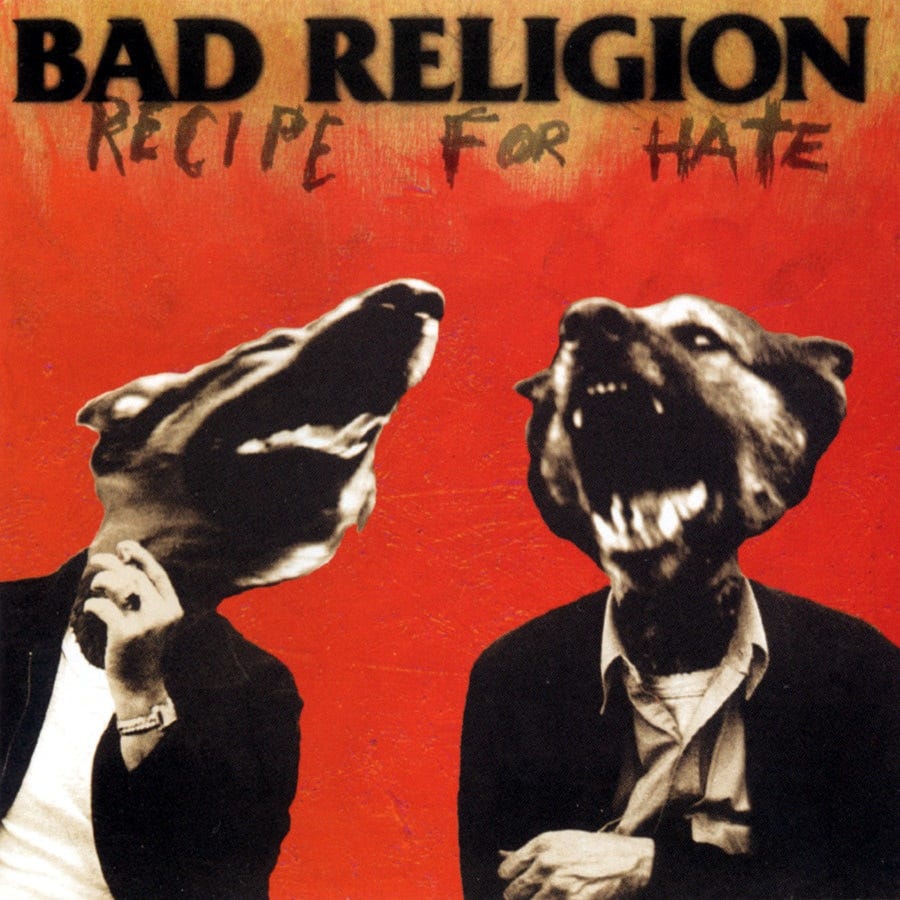
Steinbeck taught me a novel could stop telling its story just long enough to indict an entire system and dare you to keep reading anyway. Kerouac taught me that disgust with a hollow national promise could be its own aesthetic, its own reason to keep moving. Fitzgerald taught me the American Dream could be staged as tragedy, dressed beautifully, rotting underneath. Graffin didn’t introduce me to any of that. He translated it into three chords, a scream, and thirty-seven minutes; something in me recognized the language immediately.
That’s the only way I can explain why an album largely dismissed at the time as just another loud, angry punk record has stuck with me for over three decades as something closer to scripture.
“American Jesus,” the album’s most enduring track, does the same work from a different angle — dismantling the specific, dangerous comfort of believing a nation has been personally blessed above all others, and that its violence is therefore sanctified rather than just violence.
Released June 4, 1993, Recipe for Hate was Bad Religion’s seventh album and their last on Epitaph before jumping to Atlantic — the record that finally cracked a chart, debuting at number 14 on Billboard’s Heatseekers list. It’s easy to forget, given how unhinged the band’s reputation was, that Greg Graffin holds a doctorate and spent years teaching evolutionary biology at Cornell. This was never a record built on inarticulate rage. It’s an argument, constructed by someone trained to build arguments — trading the professor’s authority for punk’s sneer, but the instinct to teach never left him.
The album’s title track doesn’t waste time on any single villain. It traces something closer to a so-called free trade agreement — the way national mythology, the language of progress, and a sanitized version of history get fed into a machine that manufactures cruelty and calls the result heritage. That’s the record’s real move throughout, and it’s worth sitting with in 2026, watching Christian nationalism climb back into open daylight after decades of pretending it had gone quiet: Graffin never points at one man or one office. He points at the machinery. “American Jesus,” the album’s most enduring track, does the same work from a different angle — dismantling the specific, dangerous comfort of believing a nation has been personally blessed above all others, and that its violence is therefore sanctified rather than just violence. Thirty-two years later, you could set that song down next to this week’s headlines and it wouldn’t need a single word changed.
What I keep coming back to, though, isn’t just that the record predicted where we’d end up. It’s that it never once suggested a machine like this runs on individual villains you can simply vote out or replace. Recipe for Hate argues hate is manufactured, generationally, out of the very stories a country tells itself — its prosperity, its progress, its bloodline. You don’t dismantle a machine like that by identifying its current operator. You dismantle it by refusing to keep feeding it the same raw material, which starts with recognizing you’ve been swallowing it your whole life.
I don’t know that Recipe for Hate could have changed anything on its own, even if every person who ever heard it had internalized every word. Diagnosis was never going to be enough, and a record this uncompromising was always going to find the people already looking for it rather than the people who needed it most. But I know what it did for me, at nineteen, already primed by better books than I probably deserved, to finally hear someone my own age put a scream to what I’d only had language for in prose. Thirty-three years on, it remains one of the sharpest, most honest autopsies of what this country keeps allowing itself to become — and I still play it loud enough that the neighbors know exactly where I stand.