Without getting into too much detail, one of my brothers was diagnosed with severe ADHD during a period when it wasn’t a common diagnosis. One of the prescriptives? Give that young boy coffee. Later in life, my mother would often tell me that after the journey she went on with one of her children, that while she wasn’t a doctor, she was positive that I too suffered from the same level of ADHD but was old enough to have never received a diagnosis.
For Shaun the answer was coffee and medication, for me it was loud, heavy and fast music – even if I didn’t know why. I may not have known, but around 1983 the scientific wife-husband team of Sydney and Thomas Zentall proposed the Optimal Stimulation Theory, built on a homeostatic model: every brain has its own biologically determined optimal arousal level needed to function well, and their hypothesis was that ADHD brains run chronically under-aroused relative to that target.
That’s an awful long way to go to say listening to Acid Bath’s When the Kite String Pops serves as a calming hand in the storm that is often my rapid-fire, ping-pong brain.
Acid Bath arrived on the New Orleans sludge scene to a landscape already occupied by the likes of Crowbar and Eyehategod, while finding a way to push past both. “The Blue,” the album’s opener, sets the chaos in motion with a bluesy swamp-metal riff before winding through a series of tempo changes, leaving one breathless in an effort to keep up. The feedback from the guitar acts as a warning klaxon, emoting the same feel one gets from a fire alarm going off. Riggs’ vocals dance between distorted and clean, a push-pull that keeps you slightly unbalanced, in a message that announces this is an album not to be trifled with.
But it’s the second song on the album, “Tranquilized,” that truly finds me mentally in a lotus pose, my mind finally finding serenity. The circular guitar riff drones like a chant, lingering just long enough to draw you in as Dax Riggs melodically utters the first words of his poetry as the rest of the band joins in.
And then they do that thing I LOVE.
The whole song stops for half-a-heartbeat before exploding back into your ears -- in the nearly 20 years I’ve been listening to this album, I don’t think there’s ever been a moment where that second doesn’t bring a calm smile to my face. And just when you think you’ve got this record figured out, along comes something more analogous in sound to goth luminaries Bauhaus – “Scream of the Butterfly” shares real musical DNA with “The Spy in the Cab,” and it’s worth naming exactly why: both songs open on a restrained, hinted-at riff that builds dread through withholding rather than volume, Bauhaus’s on guitar, Acid Bath’s on bass, and both Dax Riggs and Peter Murphy shape their vocal melody around the line the strings already laid down rather than singing over it. Same architecture, different instrument carrying the weight. Go ahead, try and pin this record down. I dare you, ‘cause up next is “Dr. Suess is Dead.”
I can’t help but think when the term sludge or swamp-rock was invented, this was the song they had in mind. The track opens with a languid, droning guitar as a down-in-the-basement deep, guttural bass drops the same note three times before Riggs’ vocals scream the song’s title in something that calls into existence Baba Yaga and her minions. It’s slow, it’s driving, it’s exactly the sort of brain-shattering heaviness that people inclined this way crave. Slowly the song increases in tempo, reaching a frenetic pace that promises to explode just before dropping back down to its original tempo. This is the kind of track that when I hear it playing on the speakers of a record store, I know I’ve found a keeper.
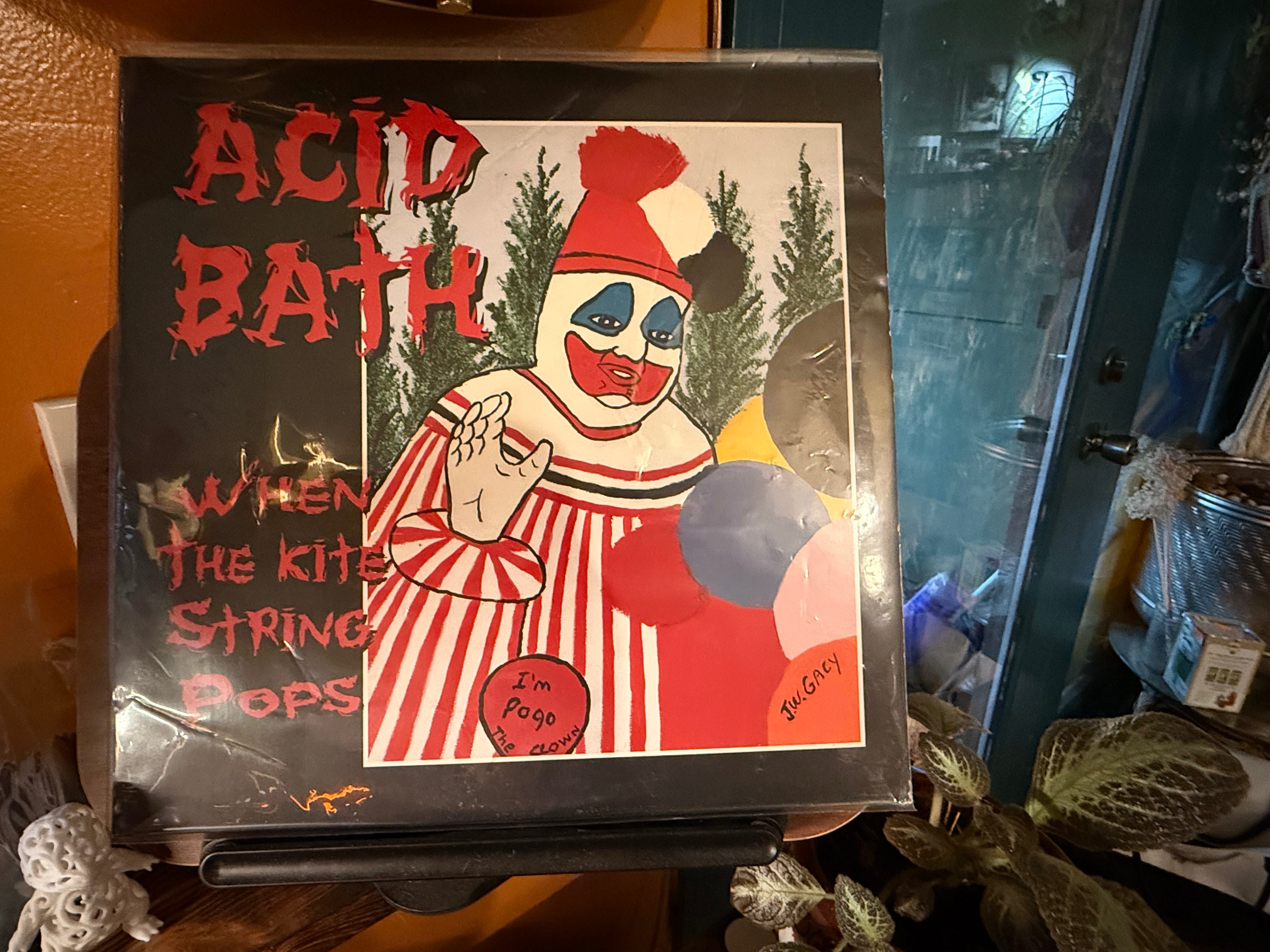
Released August 8, 1994, on Rotten Records, the debut from this Houma, Louisiana band arrived already wearing its fuck you on its sleeve in the form of a John Wayne Gacy “Pogo the Clown” painting, a provocation daring you to pick it up. Here’s the piece lost on those who’ve never lived inside a mind that never shuts up – this album isn’t extreme to everyone.
While some will hear noise, anxiety, a not-so-thinly veiled threat, other ears, my ears, hear something closer to recognition. See, I’m already operating from a place of private chaos, my own private Idaho to borrow a line from the B-52s, a feverish pitch that quiet music often can’t reach. Calm doesn’t always arrive as silence. Sometimes it arrives as the first sound all day that isn’t asking you to be calmer than you actually are.
The band never got to prove what came next. Bassist Audie Pitre, along with his parents, died in a 1997 car accident, ending Acid Bath after just two albums. What’s left is this one, still doing exactly what it was built to do three decades later — not shocking, not extreme, just accurate, for anyone whose baseline was already running this loud.