


Listen to their first studio album beginning to end and you quickly realize Die Spitz turned the idea of something to consume into a weapon. In a day and age built for algorithms, built for one-minute TikTok clips, Something to Consume exists as a whole — a deliberate act of subversion. To remove any single track from the album would degrade it — shut your mouth, show your face, American Porn.
The foursome put the jet-black, souped-up muscle car into gear — think Stephen King’s Christine — shifting to drive with the opening number, “Pop Punk Anthem (Sorry for the Delay)”, refusing to take their foot off the gas until the last sonic entry, “A Strange Moon/Selenophilia,” finally allows you to catch your breath. Melding punk, metal, and grunge into something uniquely theirs, the feral intensity of the album drips with rage at a late-stage capitalist society that finds the four wanting something to fill the void.
Most reviews of Something to Consume have drawn comparisons to Hole. It’s a fair line to draw but stop there and you haven’t done the work of actually listening to what’s in front of you. Both bands are drawing from a deep well where torrents of rage and the specific textures of feminine fury get channeled through an electric guitar. Patti Smith, Kathleen Hanna, PJ Harvey, Kim Gordon — they’re all in that water. The well predates Hole and will outlive them all. Courtney Love just got there first in a way the mainstream couldn’t ignore.
All wells are simply veins into deeper aquifers and deep in the well Die Spitz is drawing from you’ll find Black Sabbath, the Pixies, Mudhoney, Mazzy Star, Deftones, and Nirvana — all points of reference for a generation that came of age when so much of rock’s storied history was already behind them, the future still to be written. The future of this band began in Texas.
Eleanor (Ellie) Livingston and Ava Schrobilgen, friends since preschool, split vocal duties with both women playing guitar. They met Kate Halter in middle school wrapping her into the fold. Kate learned to play bass specifically to start the band — something the women have described as a way to spend more time together during Covid lockdowns.
But something was still missing. The thing coming out of their amps wasn’t matching what was in their heads.
“We were missing a piece,” says Ellie. “We wanted a drummer, someone who could help convey the heavy sound we wanted to achieve. We only had about 1 or 2 friends outside of each other at the time. We were then gifted by the grace of God (our friend Molly from the Austin band Sludge) who let us borrow her absolute machine of a drummer (Chloe). This was the piece we had missed; with her added, Die Spitz became a reality. We’d always had the energy and the motivation, and after the puzzle piece fit, with hours of practicing Sabbath riffs and scales, we were able to get the sound,” they said in an interview with Austin’s KUTX.
The thing is this — go into Something to Consume armed with anything I’ve written, or the words of any other writer who’s covered this album, and you will fall into a trap. Every reference point, every signpost, every name-dropped influence becomes a lens that distorts more than it clarifies. I know because I did it. First listen I was playing whack-a-band with every track, pegging an identity only to have the next song blow it apart. By the third listen I finally understood what was required: Shoshin — the Zen concept of the beginner’s mind. Set down everything you think you know and just hear the band as the band.
Do that and Something to Consume will reward you. Yes, the influences are all there. But it took Ava, Ellie, Kate and Chloe — their specific history, their particular set of circumstances, the years of friendship before a note was ever recorded — to make the whole something greater than the sum of its parts. That alchemy belongs to them alone.
So, if you’re following along, at this point you’ve stopped reading and just put the album on. No seriously, go do that.
No? Still here? Ok.
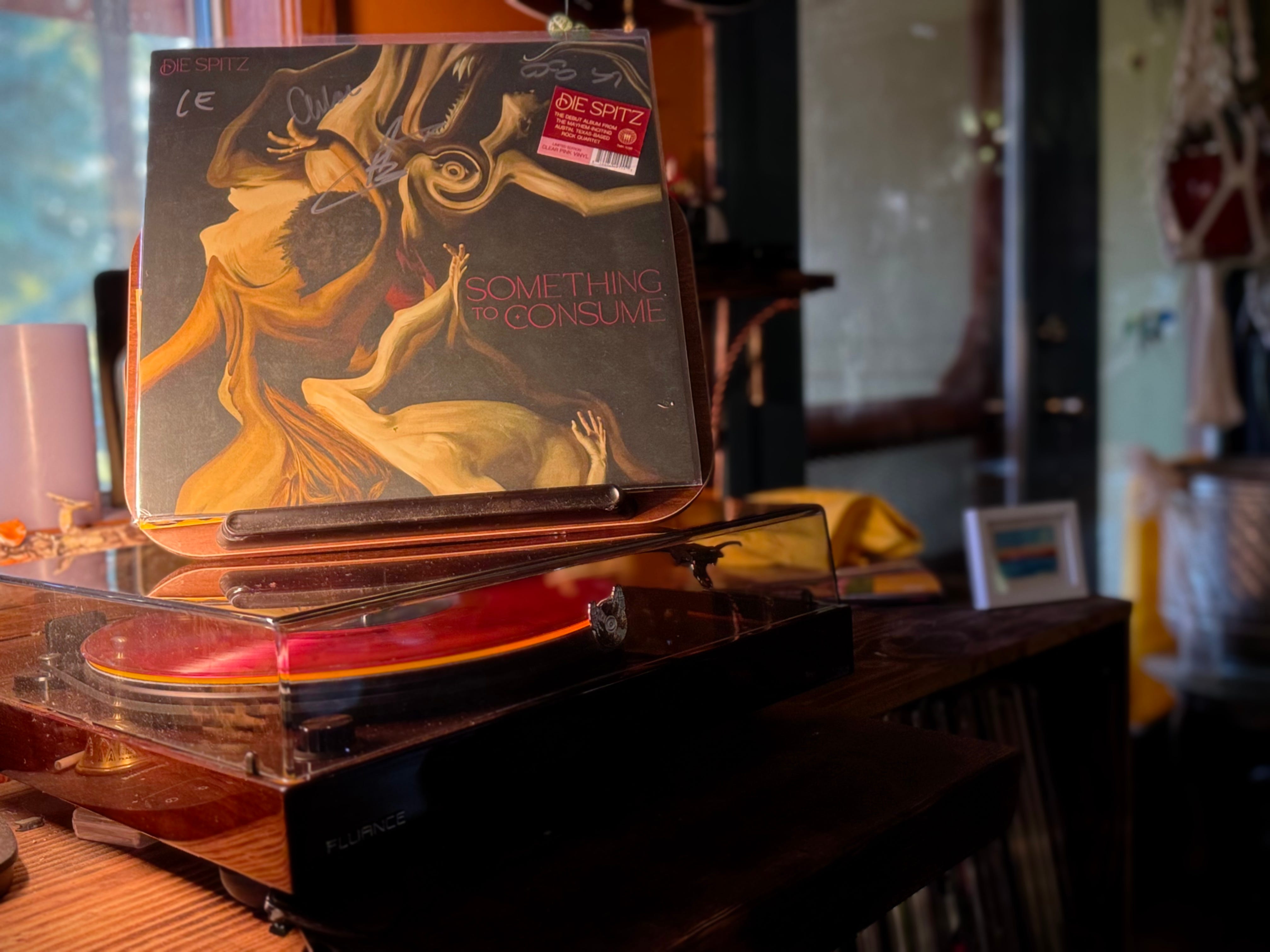
Good players in a game will tell you exactly what they’re about to do with varying degrees of success. Armed with the information you feel prepared to put up a reasonable defense — you know what’s coming, right? The best players tell you what they’re about to do and then go ahead and do it successfully anyway. So it is with Die Spitz. The album opens with “Pop Punk Anthem (Sorry for the Delay).” You know what’s coming, you’re ready — until around the one-minute mark when the song takes a hard left and your whole game plan is upended.
I warned you.
The slow burn of the opening lures you in, the haunting, almost yearning vocals lull you into a false sense of serenity as the jangly guitars promise comfort and familiarity. Then the bomb goes off. The yearning vocal turns into a fierce growl, the comforting guitars shift to a metal riff that blows your hair back.
And that’s just the setup.
“Throw Yourself to the Sword,” with its Slayer-like riff, is the battle cry. This is the album’s barn burner with the band holding the drip torches, the mixture set to burn hot. With her lyrics barked as much as sung, Ellie absolutely dares you to fuck with her — there will be consequences.
“American Porn” arrives with a wink-and-a-nod title, immediately feeling at home in an early nineties Seattle bar alongside Bleach, Facelift and Superfuzz Bigmuff on the tabletop jukebox. Pulling another switcheroo, Ava takes the vocal lead, channeling Kurt Cobain in her wail. The similarity doesn’t end there — “American Porn” takes on influencer culture the same way Cobain addressed it with “In Bloom.” There’s always been someone willing to sell their soul for fifteen minutes of fame. The names may have changed. The game hasn’t.
Catch your breath. We’re not done here.
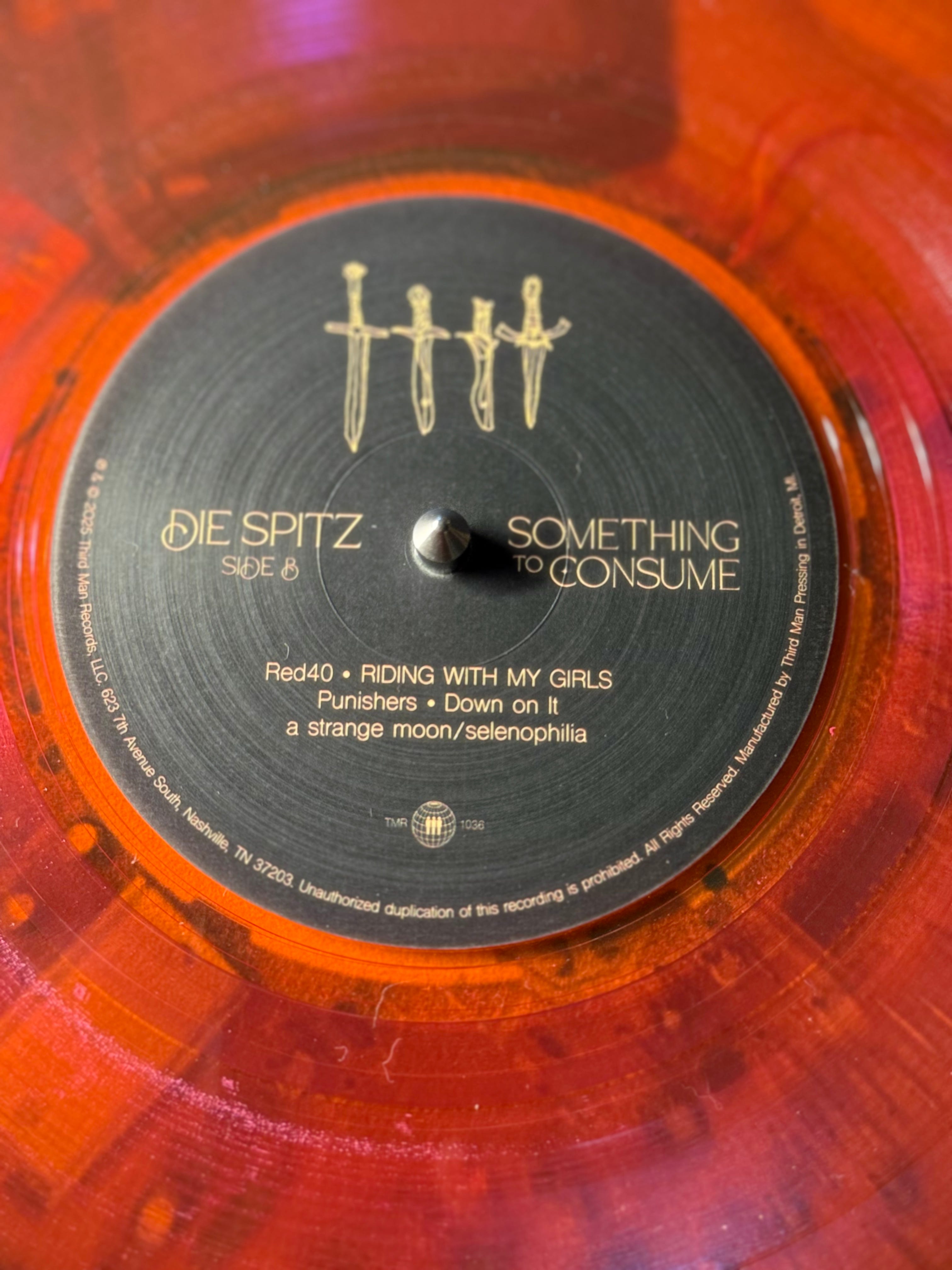
Chloe opens “Sound to No One” and lays down a foundational beat built upon layer by layer until Ellie hauntingly comes in over a crunchy, maddening, heavy riff that repeats and resolves into a dream sequence of a bridge — threatening to bring you back down to earth. Which it does, only for you to realize you’re about to be burned alive upon reentry as the intensity ratchets right back up.
Something to Consume is as much a manifesto as it is a thesis. If it has a message, it’s this: We’re here to rock hard. We’re going to have a damn good time doing it with these people for as long as we possibly can. Try us. It’s a puzzle that only makes sense once all the pieces lock into place. It’s a picture of lifelong friendship, generational rage, and a demand that something better come along — lest we all go down in flames of complicity.