

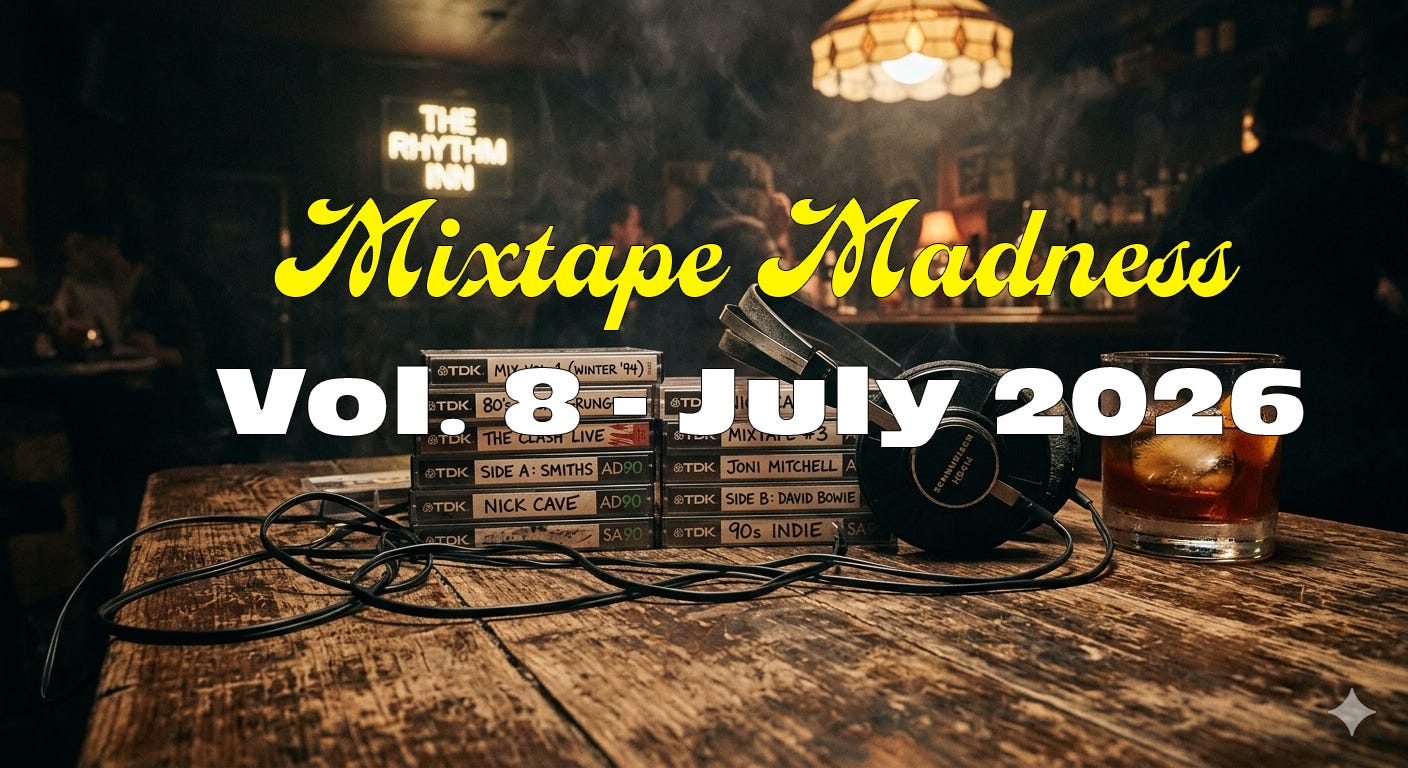
All of us have that one sweater we love, but we’ve had it so long it started to get threadbare. You’re never quite sure what you’re going to get when you pull on one of the loose threads — might come out quickly, might unravel the whole thing, you might pull, think better of the idea and just clip the damn thing with some scissors. This is a mixtape of pulling threads, of seeing where things go, and what they inspired. Side A focuses on the more personal with Side B taking a bigger stab at American music broadly and the whole thing wraps back around with the ending feeding the beginning. Where would you have stopped pulling the thread?
🎧 Qobuz | Apple Music | YouTube
Side A
1. Patti Smith – Free Money (3:53)
Before there were Riot Grrrls, before Courtney Love was writing screeds against the music industry, there was Patti Smith loudly smashing through doors. Horses remains one of the most essential albums in the canon — raw, literary, and entirely on her own terms.
2. The Stooges – I Wanna Be Your Dog (3:09)
Along with their Detroit peers MC5, The Stooges were punk before there were proto and post prefixes attached to bands. They were just doing what seemed right to them, capturing the essence of the gritty Detroit scene they were a part of, and on the way they dug a well so deep many bands would return to over the years.
3. New York Dolls – Personality Crisis (3:41)
It’s a defensible point that without the Dolls there is no Sex Pistols and no everything that came after. Built as much around image as music, the Dolls were explosive and confrontational — proof that rock and roll could be provocative in an era drowning in Album Oriented Rock and Adult Contemporary.
4. Wire – I am the Fly (2:40)
The future luminaries who cite this band as one of the most influential they were listening to reads like a who’s who of 1980s alternative rock. Still going in 2026, Wire is one of those bands who are essential to so many future artists but remain a footnote to anyone beyond the most dedicated listeners.
5. Mission of Burma – That’s When I Reach for My Revolver (3:53)
Following in the same footsteps as Wire, this Boston-based post-punk band has been cited by R.E.M., Nirvana, Sonic Youth, and even Moby as influential in their artistic development. These guys pushed the boundaries with avant-garde sonic experimentation, raw energy, and uncompromising artistic audacity.
6. Hüsker Dü – Pink Turns to Blue (2:39)
Zen Arcade is still considered the framework by which so many future bands — especially those hailing from Seattle — would follow on their way to ushering in the Grunge Movement. Brutal and abrasive in all the right places, its aggression was balanced by melodic and experimental elements that elevated the album from artistic indulgence to a true masterpiece of the era.
7. The Jesus and Mary Chain – Head On (4:11)
A recurring motif with bands serving as headwaters is they existed in a genre before the genre had a name. Shoegaze is a term most music people know and use on a regular basis, but when The Jesus and Mary Chain were deploying their wall of sonic fuzz across eight studio albums, no such term existed. They weren’t inventing a genre — they were just following the sound wherever it went.
8. The Cramps – Way I Walk (2:30)
Smash punk’s raw energy into rockabilly’s twangy guitar sound with a healthy dose of horror and you’ve got the Cramps. There is arguably no band more responsible for defining psychobilly than the combination of Lux Interior and Poison Ivy Rorschach.
9. Sonic Youth – Teen Age Riot (3:50)
From here we start to get into second and third wave headwaters. Building on everything before them, Sonic Youth redefined what rock guitar was capable of as they embraced unconventional guitar tunings and feedback to create dense textured sounds, putting into motion a future that gave rise to alternative, indie, and noise rock.
10. The Pixies – Gigantic (3:58)
No one does soft-loud-soft like the Pixies. There was a time where Boston could lay claim as a musical hub and the Pixies found themselves in those fertile grounds as they developed their signature sound evidenced on Surfer Rosa, their second studio album. In their wake they left the blueprint for what alternative rock sounded like and bands like Radiohead and Nirvana took notice.
11. Nirvana – Radio Friendly Unit Shifter (4:51)
There is a current underfoot in the music of today’s youth. It doesn’t take an astute listener to hear the sonic fingerprints of arguably Seattle’s most influential band. It’s hard to remember there was a time when Nirvana was only a band from Aberdeen who found solace in the Seattle community before they would go on to define a generation while displacing Michael Jackson from the top of the charts.
Side B
1. Ma Rainey – Prove It on Me Blues (3:15)
Arguably one of the most important people in blues and subsequently rock and roll. Recorded in 1928, her influence stems from her pioneering role in shaping the sound, style, and cultural impact of the blues, as well as her broader contributions to African American performance traditions.
2. Skip James – Hard Time Killing Floor Blues (3:24)
Forgotten and then found again. Haunting falsetto, songs that lived in minor keys featuring intricate fingerpicking — James’ music would make the hairs on the back of your neck stand straight up. Robert Johnson took two of James’ most famous songs — Devil Got My Women and 22-20 Blues — and refashioned them into Hellhound on My Trail and 32-20 Blues. Rediscovered during the blues revival of the 1960s, his reach spanned generations all the way to the White Stripes.
3. Jimmie Rodgers – Mule Skinner Blues (2:50)
The father of country music. Rodgers blended folk, blues, jazz, and yodeling in a way unheard of at the time. The list of influences reads like a who’s who in the country music world — Waylon Jennings, Johnny Cash, Bill Monroe, and Dolly Parton.
4. Howlin’ Wolf – Smokestack Lightning (2:32)
Take the delta blues sound, move it north to Chicago, plug it in and electrify it. No one is more responsible for the Chicago sound than Howlin’ Wolf, with the likes of Jimi Hendrix, The Rolling Stones, and Tom Waits claiming a sonic nod to the legendary bluesman.
5. Django Reinhardt – Djangology (approx. 3:00)
While tastemakers and critics alike love to put music in a box, filed neatly in a specific genre, music is constantly in conversation with itself. Blues speaks jazz, both speak rock and roll. Reinhardt brought a mastery and a style — gypsy jazz — to the main stage with inventive riffs and sounds that artists like Tony Iommi of Black Sabbath and Jerry Garcia would later note had a strong influence on their development around the guitar.
6. Robert Johnson – Cross Road Blues (2:39)
Some influences flow beneath the surface; others rage like a torrent filling every space they find. Robert Johnson is one such artist. His music preserved and expanded the Delta Blues sound and found its way into the ears of nearly every rock guitarist that came after him.
7. Hank Williams – Lost Highway (approx. 2:45)
With his distinctive voice and unique songwriting style, Williams defined the Honky Tonk style and is still widely represented from dive bars to the Grand Ole Opry — of which he is still not allowed back in — his music reinterpreted across punk, rock, and country acts alike.
8. Woody Guthrie – This Land Is Your Land (approx. 2:30)
This machine kills fascists — not just a label on his guitar but a mission of the man. Guthrie gave voice to the migrant and the working class with his blend of folk, country, and blues that featured political and social commentary. His most famous work, This Land Is Your Land, often gets dressed up and rolled out for a bit of patriotic jingoism — the first verse the only bit played. Dig deeper and the track takes on a whole new light with incisive social commentary.
9. Billie Holiday – Strange Fruit (3:02)
If this was the only song Holiday ever performed, she would still rank as one of the most important figures in American music. Thankfully for all of us, Holiday’s revolutionary vocal styling, emotional depth, and fearless engagement with social issues were a hallmark and not a one-off for the performer.
10. Chuck Berry – No Particular Place to Go (2:37)
The matriarchs and patriarchs of American music fill this side and Chuck Berry is no exception. The father of rock and roll, Berry’s inventive guitar techniques of double-stop bends, staccato rhythms, and rapid solos became the blueprint that nearly all subsequent acts would follow.
11. Link Wray – Rumble (approx. 2:15)
What is rock if not for the power chord, and what is the power chord without Link Wray? Experimenting with fuzz and distortion, Wray pioneered the raw, driving sound acts like the Stooges would go on to adopt. Looking at it with today’s eyes, it’s near impossible to think there was a time when Wray’s signature song Rumble was considered so incendiary it was banned in multiple places across the country.
12. Buddy Holly – Rave On (1:47)
Take a dash of country, a dash of rhythm and blues, and throw in some Texas twang and you’ve got Buddy Holly. A pioneer of his day, Holly was one of the first artists to play around in-house with overdubbing and double tracking, while his signature hiccup vocal style set him apart from nearly every performer of the day.
13. The Beatles – I Want You (She’s So Heavy) (7:47)
This mix was always intentionally designed as a circle — nearly everything before the Beatles had some sort of an influence on them, while nearly everything since, the Fab Four have had some sort of an influence on. Will the Circle Be Unbroken? As long as music continues to maintain its conversation with itself, no.
Whhaaaattttt... the Stooges did I Wanna Be Your Dog first?!?! Thought I was hearing it first-time round by Sid Vicious (Gary Oldman) via Sid and Nancy soundtrack. My punk compass has been reset.:)