

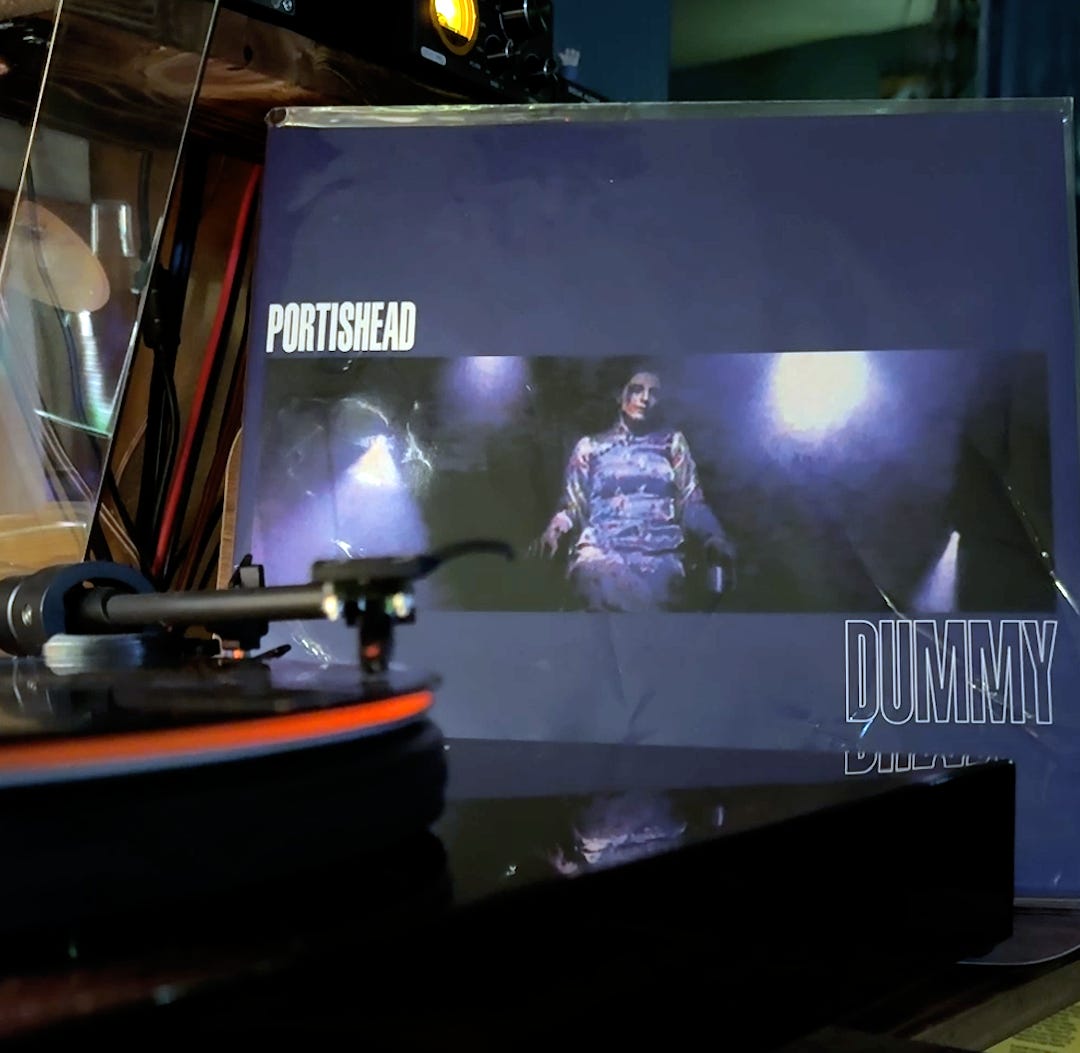
When Portishead dropped their debut album Dummy in 1994, little did they know they were about to start a revolution while laying the groundwork for a whole new genre along the way. This was the same year Oasis released Definitely Maybe, Green Day pushed out Dookie, Weezer was pulling on sweaters, and the grunge scene was in full force.
Dummy was different from anything coming out in that era. Where Soundgarden’s Superunknown (1994) was loud and crunchy — the sound of a band solidifying their walk towards rock legend status — Portishead’s release was brooding, moody, deeply atmospheric and the near opposite of everything flowing out of the alternative radio airwaves at the time.
Comprised of Beth Gibbons (vocals/lyrics), Geoff Barrow (producer/multi-instrumentalist) and Adrian Utley (guitarist/multi-instrumentalist), the group formed in Bristol, their iconic name arriving by happy accident. In an expansive interview with KEXP celebrating the 25th anniversary of the album, Barrow described the moment their eventual A&R man, Ferdy Unger-Hamilton, was sitting on the toilet reading a copy of Music Week and noticed a line explaining that Neneh Cherry was working with the guys from Portishead — the small coastal town where Barrow grew up.
“We didn’t have a name then, and that’s how we got the name Portishead,” Barrow said.
A music trade publication had jumped the gun and named them after their hometown before they’d settled on anything themselves, and it stuck. Not quite the glamorous origin story you might expect for such an evocative name, but it has a certain charm to it. More importantly, the name ended up suiting the music perfectly — that sense of a grey, coastal, slightly melancholy English town feels entirely fitting for the atmosphere of Dummy.
But what made the album special in a year of special albums? Even having lived through that year deeply immersed in music, it’s hard to wrap one’s head around just how many records were coming out that would go on to become iconic in their own right. While one could draw sonic parallels between many of the releases that year, absolutely nothing sounded like Dummy. Much of that uniqueness can be traced to the painstaking recording process the group undertook while working on a shoestring budget.
The album famously built its sound by sampling obscure library music, film soundtracks, and jazz records — but with a twist. Rather than sampling directly, Barrow and the team would often re-record the samples live, then sample their own recordings to get that degraded, worn quality. This gave the album its distinctively dusty, aged texture. To achieve that lo-fi, haunted feel, they deliberately ran recordings through old equipment, added tape hiss, and used filtering to make things sound like they’d been played off a battered vinyl record. The crackle and warmth is largely manufactured rather than incidental — but damn does it sound good.
The band also had an unusual origin story of their own. Barrow had been working with Neneh Cherry on her second album Homebrew (1992), hired by her husband Cameron McVey. It was in Cherry’s London kitchen, of all places, that Barrow and Gibbons first began sketching out what would eventually become Dummy — stealing time between sessions to develop their own ideas. Bristol’s music scene in the early nineties was small and deeply interconnected, and that proximity to Cherry’s world, to Massive Attack, to DJ Andy Smith’s extraordinary record collection, fed directly into the DNA of the album.
And then there is Beth Gibbons. To understand what makes her remarkable, it helps to remember the landscape she emerged from. At the same time Dummy was released, female artists were staging a full-on coup in the music industry, smashing through in ways they hadn’t in the past. Hope Sandoval of Mazzy Star was brooding her way through So Tonight That I May See (1993). Tori Amos was lighting the world on fire with Under the Pink (1994). PJ Harvey had delivered the ferocious Rid of Me (1993). Liz Phair had rewritten the rules with Exile in Guyville (1993). These were extraordinary, distinctive voices — and yet Gibbons sounded like none of them. Her delivery combined raw, slightly fractured vulnerability with a kind of torch song theatricality that felt like it came from an entirely different era. To find a true analog you have to travel back to Billie Holiday or Nina Simone — singers for whom the performance cost something, where every note felt like a confession. Two songs in particular show exactly what Gibbons brought to this record.
Glory Box is, in this writer’s contention, Portishead’s signature song. While not the biggest commercial hit on the album, if you were to ask a hundred random people about the band, this is the one they’d probably come up with. Built around a smoldering Isaac Hayes sample, the track is one long slow burn, and Gibbons’ performance is absolutely devastating. From the coy, slithering opening to her full-throated delivery of the line “For if this is the beginning of forever and ever, it’s time to move over” near the denouement — if you have a romantic bone in your body, this song will leave you on the ground, exhausted from the emotional journey.
If Glory Box is the signature, then Roads is Dummy‘s heart and soul. The song was never released as a single — a deliberate choice that speaks to everything Portishead valued as artists. Releasing it, remixing it for radio, marketing it as a hit would have compromised the very quality that makes it extraordinary. By leaving it as an album track, they forced listeners to find it themselves, to discover it in context, which may be precisely why it has endured with such emotional force. Roads is also unique in the Dummy catalogue in that it contains no samples whatsoever — unlike virtually everything else on the record, it was built entirely from live instrumentation, stripped down to sparse piano, strings, Adrian Utley’s weeping guitar, and the power of Gibbons’ unsettling, forlorn voice. For this writer, it is the song that brings her vocal talent to its greatest use. From the moment she begins singing, her vulnerability is palpable, her need urgent and deeply sincere. The lilting vibrato only adds to the emotional impact — is she scared? Anxious? None of that matters. You’re left absolutely wrecked, and somehow ready to slay dragons for the person singing.
When they say they don’t make them like they used to, that is especially true of Dummy. More than thirty years in the rearview mirror, the album continues to resonate — perhaps even more so with today’s audience than when it was first released. Authenticity, passion, and genius never go out of style, and Portishead’s debut remains living proof of that every single day.