

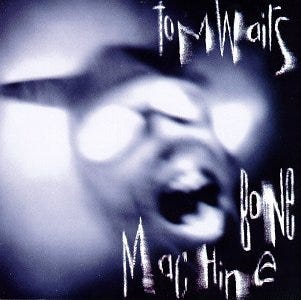
There is a moment in every serious artist’s career where they decide, consciously or not, to burn the old version of themselves to the ground. For Tom Waits, that moment didn’t arrive all at once — it came in stages, a slow immolation that began with 1983’s Swordfishtrombones and found its scorched, magnificent conclusion nine years later with Bone Machine. By the time the last note faded on that 1992 release, the lounge-lizard piano man — the rakish, Rain Dogs-era romantic — was gone for good. What replaced him was something far more unsettling and, in its own way, far more extraordinary.
Consider what Bone Machine accomplished in a single release. It served as the closing chapter of a trilogy that began with Swordfishtrombones and continued through 1985’s Rain Dogs — three albums that collectively rewired what a Tom Waits record could be. It handed Island Records its walking papers, ending a relationship that had run its course. And in 1993, it delivered Waits his first Grammy, winning Best Alternative Music Album in a category that had no business containing something this feral. The Grammy voters probably didn’t know what they were approving. They were right to approve it.
The album announces its intentions immediately. And the Earth Died Screaming opens not with a piano, not with a chord, but with the pulsating beat of bamboo rods being struck. In an interview, Waits explained that he moved the entire recording studio outside to capture what he called his “pygmy percussion unit” — the band striking concrete with sticks in the open air, a sound that is simultaneously ancient and industrial. It’s a technique he’d return to decades later, showing up most recently on “Boots on the Ground,” his 2026 collaboration with Massive Attack, where that same primal percussion logic anchors an entirely different kind of darkness. But here, on Bone Machine, it serves as a threshold — cross it, and the almost hypnotic thrashing erupts into Waits’ bark and growl, and suddenly you’ve awoken from a dream into a nightmare. You’ve been warned. You’re in anyway.
The production throughout is deliberately primitive, and not accidentally so. Waits recorded much of Bone Machine in a warehouse, using found percussion, metal scraps, and unconventional microphone placements to achieve a sound that is less rock album and more field recording from the end of the world. Drums were recorded in a corrugated tin shed specifically to get a particular hollow clang — that specific resonance of something struck inside a container that was never meant to hold music. The overall effect is cavernous and decayed, a record that sounds like it was unearthed rather than made.
And then there is the Conundrum.
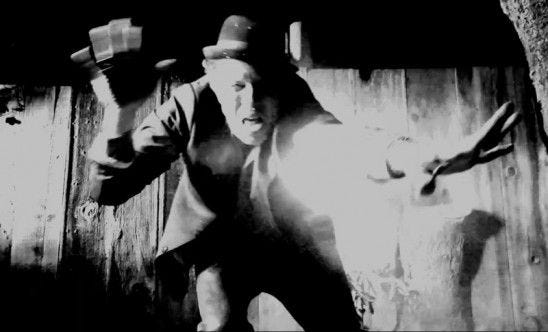
Among the instruments Waits employed is a custom-built percussion rack: a large iron cross with various found metal objects hanging from it — crowbars, farm equipment, the detritus of a working life — whacked with hammers and mallets to produce a sound not unlike a jail door closing. This is the instrument of Bone Machine. This is the philosophy of Bone Machine. Tom Waits didn’t just write songs for this album. He built the machines that made the sounds that became the songs.
Clocking in at 54 minutes across 16 tracks, Bone Machine covers more emotional and sonic territory than most artists manage in an entire career. Waits has always maintained that he writes one of three types of songs — a brawler, a bawler, or a bastard — and all three are present here in abundance.
The brawlers announce themselves without apology. Going Out West is Waits’ most well-known song for good reason — a blues-drenched, all-out rocker that became famous to a generation through its prominent placement in Fight Club, covered by artists worldwide, and still capable of rearranging the furniture when it comes through a decent pair of speakers. In the Colosseum belongs in the same category, a track that sounds like the Roman arena it references brutal, spectacular, and faintly obscene.
The bawlers provide the emotional center. Dirt in the Ground is the album’s beating, mournful heart — Waits contemplating life, death, the meaning of it all, and arriving at the same conclusion every honest reckoning arrives at: we’re all going to be dirt in the ground. It’s the kind of song that makes you want to call someone you haven’t spoken to in too long. Whistle Down the Wind and A Little Rain offer moments of the older Waits, the piano-driven melancholy that built his early reputation, now seasoned with something harder and harder to name.
The bastards are where Bone Machine does its most disquieting work.
Black Wings tells the story of a Constantine-type figure in an avant-garde folk melody replete with haunting vocalizations — the kind of song that feels older than the man who wrote it, as if Waits merely transcribed something that had been floating in the dark for centuries. Jesus Gonna Be Here is an unemployed carnival barker, down on his luck, slightly drunk, plucking the last working string on his guitar as his final hopes curl and fade. These are character studies so specific and so strange that they feel more like encounters than compositions.
Perhaps the most disquieting of the collection is Murder in the Red Barn — a nearly spoken-word affair that seems to find Waits channeling the psychotically insane Renfield from Coppola’s Bram Stoker’s Dracula, released the same year. The coincidence, if it is one, feels too perfect to be accidental.
And then, sandwiched between this menagerie, sits The Ocean Doesn’t Want Me — a spoken word track that is either the album’s most darkly comic moment or its most genuinely unsettling, depending entirely on where you are in your life when you hear it. The musings of a man on the edge who cannot accomplish what he came to do, because the ocean, for reasons of its own, keeps spitting him back. I’ll go in up to here / It can’t possibly hurt / All they will find is my beer / and my shirt. It’s funny until it isn’t. It isn’t for very long.
Waits has always been a writer who understood that the space between genres is more interesting than any genre itself. Bone Machine lives entirely in that space — too abrasive for country, too literary for rock, too American for avant-garde, too strange for any category that needed a Grammy name to hold it. It is raw in the way that things are raw when someone stops caring about the finish and starts caring only about the truth of the thing underneath.
This is not the album you begin with. That task is left more comfortably to the slightly adventurous Rain Dogs or the accessible warmth of The Heart of Saturday Night. But for the initiated — for those who have already followed Waits through the carnival and the bar and the dark street outside — Bone Machine is the destination. It marked the beginning of a stellar second act that found its current conclusion in 2011’s Bad As Me, a run of records that collectively constitute one of the most extraordinary late careers in American music.
They say live fast, die hard, and leave a good-looking corpse. Bone Machine is the personification of that idea — 54 minutes of controlled demolition, a man tearing down everything he built so he could see what was underneath.
You’ve been warned. Give it a listen anyway.
Okay, I'm not normally one to abdicate my thoughts about creative things, but I'm thinking of trying it out with your musical obervations. I float around in genres, never staying too long but wishing I did, but oh so many books to read luring me away. So please keep writing all this awesome, and I'll keep lurking and learning who next to dip into for a listen. This magpie loves the musical musings.