

To say it was a cold, dark morning in Alaska is about the worst case of stating the obvious there could possibly be, but standing at the bus stop at 6:30 in the morning at the end of Melbar Road, it was one of those mornings that felt cold even by Alaska standards. My brother Patrick, Wendy, Chris, Kyla and I were all waiting for the flashing lights and our escape from the cold. After the half-mile walk to the bus stop and wearing only enough clothing to satisfy our teenage mindset, that bus couldn’t get there fast enough as we stomped around to try to stay warm in our sneakers.
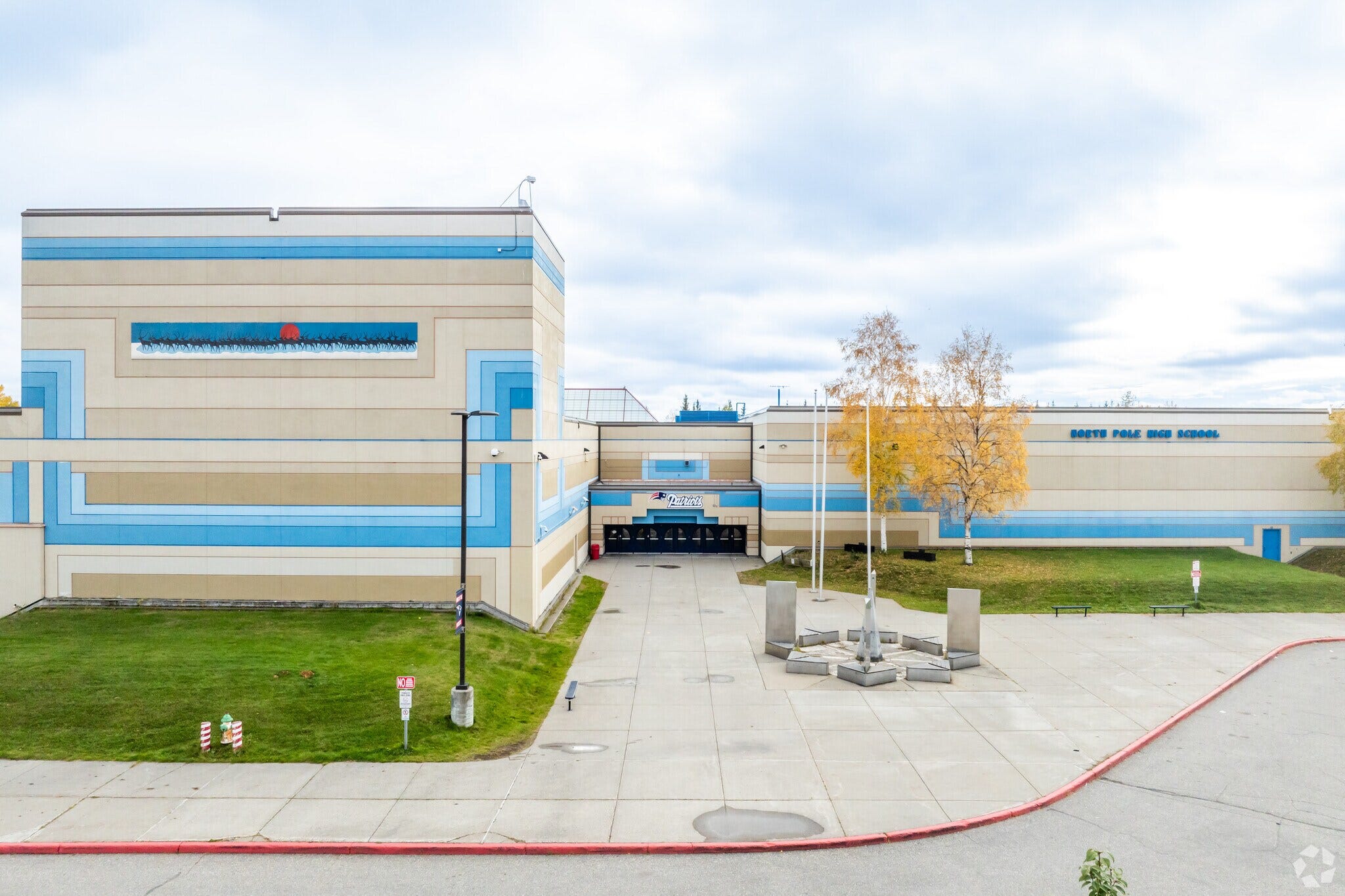
Growing up in rural Alaska, one of those things you have no choice in accepting was a long bus ride to school. From where I lived to my high school, North Pole High and Middle School, was about 30 miles and an hour or so long ride after you picked up the remaining kids. At least I wasn’t Roman, the last kid on the route. I lived at 14-mile Chena Hot Springs Road. Roman and his family lived at 50-mile.
Just a mile or so up from my stop was where Ryan Kruse got on. Ryan was one of these impossibly cool kids in a very fuck-you sort of way — tall, skinny, with an apparel aesthetic built around an armless denim jacket, band patch on the back, overtop a black leather that made me view him with a reverence typically reserved for royalty. This was 1987 and while the hippies had made long hair more acceptable, it was still strongly frowned upon in rural Alaska. Ryan had long, straight, blonde hair, the type that made the girls both swoon and swell with envy. He played guitar, smoked cigarettes in the back of the bus and, most importantly to me, he carried a boom box that would fill the bus all the way from his seat in the back with whatever he felt like listening to.
It’s hard to imagine, but there was a time when Metallica was still an underground band and listening to them was considered an act of rebellion. My eighth-grade year was sandwiched between the release of Master of Puppets (1986) and …And Justice for All (1989). Ryan was a massive Metallica fan during a time when who you listened to and how you wore it was as much a line in the sand as anything. Back then battle lines were drawn by the tapes in your Walkman. The back of the bus was filled with the Holy Trinity — Megadeth, Slayer and Metallica — with Metallica claiming the lion’s share of the airtime.

After a couple of seasons riding the bus it was 1988 and the release of …And Justice for All that finally switched me over to the dark side. Sitting between adolescence and being a teenager, Master of Puppets had seeded a garden that hadn’t yet borne fruit. I was still holding on to the music of my parents — U2’s Joshua Tree was as far as I had gone in giving voice to my own musical identity, but it wasn’t too far astray as my father also loved it. …And Justice for All was something else entirely. Maybe it was the opening song, “Blackened,” with its long, droning guitar slowly building, the tension increasing as the guitar got louder until the whole thing exploded into a fury that seemed to immediately grab me and hold a conversation with every raging hormone and emotion exploding through my 13-year-old body. Some people reminisce fondly of their mom’s macaroni and cheese or mashed potatoes — comfort food. I have comfort albums, and …And Justice for All is high on that list.
My transformation terrified my parents. Heavy metal listening was equated with the devil in an era with a Satanic Panic that rivaled anything Elvis had brought up, holding the nation in a death grip. Acts like Judas Priest were singled out, Dee Snider of Twisted Sister testified before Congress, and Ozzy Osbourne was dragged into court accused of causing the death of John McCollum through his song “Suicide Solution.” Tipper Gore had launched her Parents Music Resource Center, the PMRC, in 1985 and by 1990 the now ubiquitous Parental Advisory label found on so much music was officially launched. I bought a t-shirt with the logo emblazoned across it. Between 60 Minutes specials and the “It’s ten o’clock, do you know where your children are?” advertisements, my parents — specifically my mom — were convinced that Patrick and I were dabbling in witchcraft of the darkest sort, and a fear for our mortal souls became a defining argument in our house.
Reaching its crescendo, there came a time when my mother threatened to take every tape she deemed offensive and burn them, forbidding us from ever listening to them again. My mother was not one to make threats lightly — there were plenty of wooden spoons busted over my ass — so we had no reason to believe she wouldn’t follow through. Patrick and I went into action, stealing away downstairs when we were supposed to be in bed, using Dad’s double-deck tape recorder to dub off versions of our favorites, removing elements of the speakers in our bedroom and hiding backup copies inside, stored away in the event the inevitable came to pass. Ryan didn’t even know mine or Patrick’s name, but he’d given us something and we had picked it up — I’d be damned if I was going to let anyone take it away.
Neither Patrick nor I ever used the word transmission. Nobody did. That’s the thing about the way music moved between people in that era — it didn’t need a name because it didn’t need to be explained. It just happened, the way weather happens, the way seasons change. Ryan didn’t decide to recruit a bus full of rural Alaska kids into heavy metal. He just played what he loved, loud enough for everyone to hear, every morning for years. My mother didn’t understand that in trying to burn our tapes she was fighting something older and more stubborn than Metallica — she was fighting the way music has always moved, hand to hand, speaker to speaker, one converted listener at a time.
That chain is older than any of us. It runs from the Mississippi Delta to the back of a school bus on Chena Hot Springs Road to a double-deck tape recorder running in the dark while our parents slept. We were nodes in it without knowing it — receivers who would become transmitters, carrying something forward whether we meant to or not.
What none of us could have predicted was how thoroughly that chain would be disrupted. Napster arrived in 1999 and what followed wasn’t just a legal battle over copyright — it was the beginning of a fundamental rewiring of how music moved between people. The hand-to-hand passage, the captive audience, the accidental discovery — all of it slowly replaced first by the illusion of infinite choice and then by the algorithm’s confident whisper about what you already like. The transmission lines didn’t disappear. They were rerouted through a machine that optimized for engagement rather than surprise, for comfort rather than conversion.
But something is shifting. The younger generation — the ones who grew up with every song ever recorded available in their pocket — are the ones now buying turntables, trading cassettes, showing up at local shows. The networks are finding themselves again, slowly, imperfectly, in record stores and music venues and yes, in the back of school buses where someone’s still playing something too loud for the front seat kids. The transmission is never fully broken. It just goes underground for a while and waits for the next Ryan Kruse to get on the bus.
Over the years between my freshman and senior year, I took my seat closer and closer to the back of the bus, passing Jana and her ever-present leave-me-the-fuck-alone eyes, avoiding the Christian kids, closer to the source. Metallica was supplemented by Iron Maiden, Anthrax and Corrosion of Conformity. When Pantera came on the scene with Cowboys from Hell we all lost our minds. Ryan graduated a few years before me and with his departure so too went the boom box. Josh, a few years younger than me, had picked up that mantle and was gleefully playing the role of music tastemaker as much as he could. With Ryan’s departure I was now in full control of the back seat, Josh a few rows ahead of me.
“Hey, Ben,” Josh said as he turned around, a slight tremor in his voice as he mustered the courage to speak. “Got a smoke?”
I shot him a scowl for a second. “Yeah,” I said as I took out a Marlboro Red and passed it to him.
“What about Justice — you got a copy of Justice I could play?”
I reached into the pocket of my black leather jacket, pulled out a dubbed copy of the requested album and tossed it to him.
“Keep it.”