

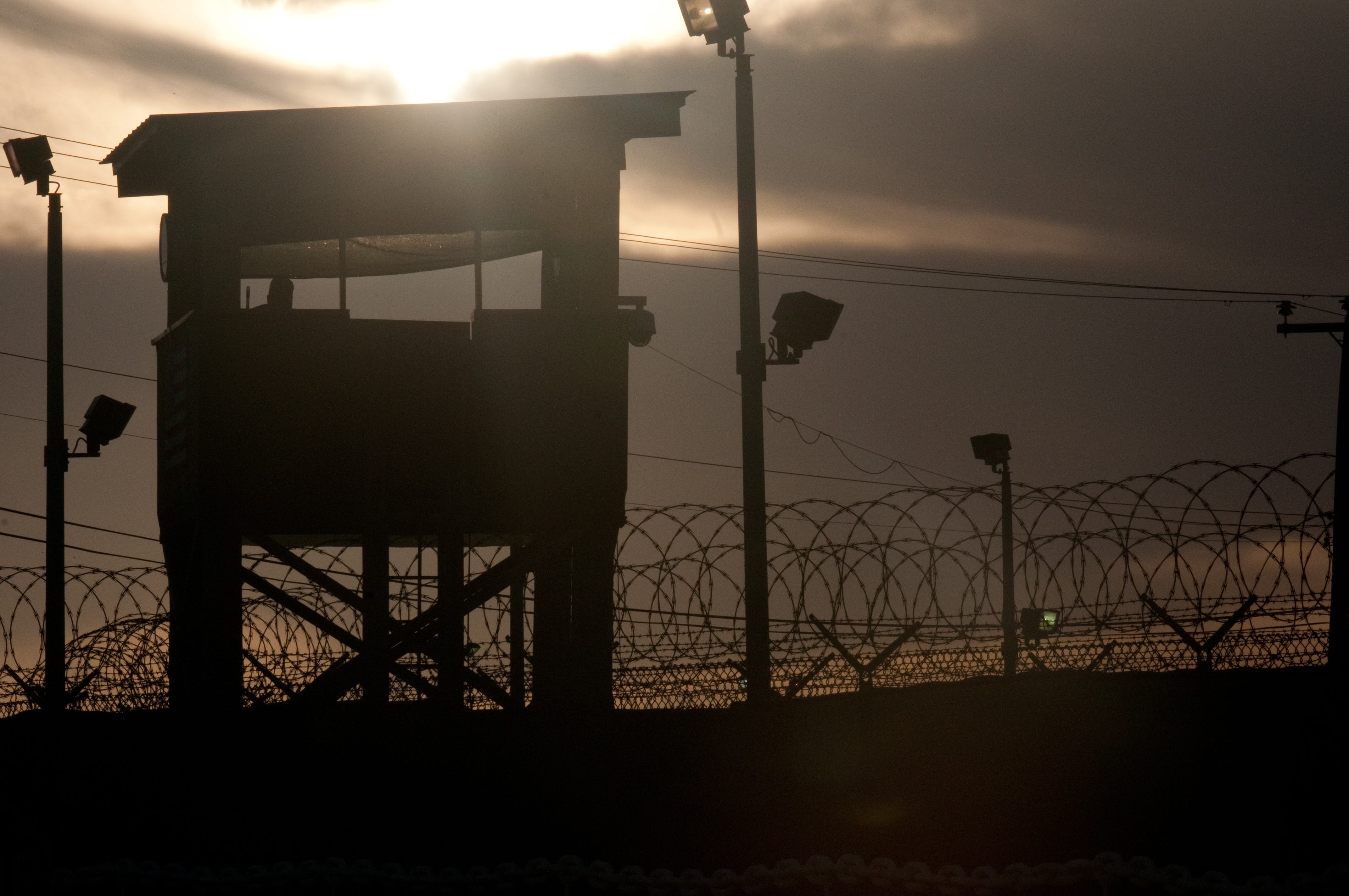
I used to think Iraq was the edge of the world. Seventeen or so miles north of Baghdad, Camp Taji felt like the last outpost on your way to Hell. Then I deployed to Guantanamo Bay. I know it seems counterintuitive but there’s something far more isolating about seeing the city lights, hearing the rich, vibrant thrum of life just outside your reach that is far more isolating than anything the Sunni Triangle threw at me. When you’re dying of thirst, is it better to have no water in sight or an oasis just beyond your grasp?
Remember back in the day when you could call into a radio station, speak to a live DJ and request a song? Maybe it was someone’s birthday, an anniversary, whatever – you called, somehow you got through, you nervously talked to that famous voice on the other side and then you waited.
Coleman was sitting at his desk across from me, my deputy there in Guantanamo. We were arguing about something inane as Soldiers and Sailors are want to do when we got on the subject of music. My routine in the morning, once I got into the office, was to connect to Seattle’s KEXP and let the calming voice of John Richards and his incredible The Morning Show fill my late morning and early afternoon.
“You’ll never get through,” Coleman said as he shot a look of smug assuredness pointed in my direction.
“Fuck you,” I shot back “Watch me.”
Picking up the phone, knowing I was about to violate several federal laws as well as play a game Russian roulette with our notoriously bad phone service, I dialed the code to get an outside line, I dialed the number – busy signal.
“Told you.”
Daggers.
I tried again, this time a tone.
“KEXP, this is John with the Morning Show, whadda wanna hear?”
A smile slowly made its way across my face as I turned to face Coleman.
“Hey John, good morning,” I stammered. “Listen, this is Ben, I’m calling from Guantanamo Bay, Cuba and I was hoping you could play “Dry the Rain” by the Beta Band for all of us here in GTMO, maybe sell a record or two.”
“Cuba?” the voice replied. “Wow, ok – we’ll see what we can do, thanks for calling.”
And I waited.
About an hour or so later, we’re all getting ready to head to the chow hall for lunch. I think I hear the unmistakable shuffle drum beat and the slow guitar strumming and then the words “This is the definition of my life/ Lying in bed in the sunlight” I glance over at Coleman, a shit eating grin spreading over my face, give him a friendly smack on the arm and we make our way out the door.

For better or worse, radio has always been a huge part of my life. Growing up in rural Alaska, our mornings were filled with the news and country music sounds of 970 AM, KIAK. As soon as I was old enough to have a preference, my love became KSUA – the quirky and off-beat college station broadcasting from the University of Alaska Fairbanks. Here was where I heard Rocky Horror for the first time and learned of Sweet Transvestites and would stay up into the wee hours of a Friday night listening to the station’s three-hour metal program that kicked off sometime around midnight.
The Marine Corps was my ticket out of the frozen hinterlands and the culture shock going from Fairbanks to San Diego in late January of 1993 is hard to overstate. Marine Corps bootcamp has undergone major changes since I stepped foot on those golden footprints but back then your final week before graduation was spent in what they called service week. Essentially it was free labor for the Recruit Depot as recruits worked in the chow halls, mowed lawns and cleaned common areas of the barracks. I was assigned the barracks detail.
For the last 80 or so days I had been completely cut off from any culture so when I heard music coming from someone’s room it was like a moth being called to the flame. The song was magic, crushing and ear splitting at the same time delicate and all I would remember for the next few weeks was “But I’m a creep.” And the words “Equis tay erre ah efe eme Baja California Mexico – 91X.”
Back from boot leave and on to my first duty station, Camp Pendleton, I had a mission – find that song, find that radio station. Neither was hard, Radiohead’s “Creep” was blowing up across the nation and 91X was a San Diego institution going toe-to-toe with Los Angeles’ KROQ. In the early 90s San Diego was still pretty proud of its anti-LA character and hadn’t fully embraced it’s “America’s Finest City” identity. Los Angeles was spit and polish, San Diego was scrappy and edgy, Los Angeles had Richard Blade, San Diego had Michael “Hooligan” Halloran. Sandwiched between the two metros areas, I had them both.
In my car and in my office, the radio dial lived on 91x. And yet, a friend of mine from LA and I would, most nights, find ourselves parked on the beaches of San Clemente in Richard’s Dodge Neon, the better to hear Dr. Drew and Riki Rachtman give sex advice to an eager and young KROQ audience. For four glorious years, those two stations were the soundtrack and social calendar of my life. Concerts hosted by both consumed my free days and the in-between moments were filled with DJs electrifying my ears.
Near the end of my Marine Corps tenure, Congress passed the Telecommunications Act of 1996. While I was busy preparing to separate from a life of military service, Congress was busy separating radio stations from the local communities they served. Was this what they intended to do? I’m just jaded and cynical enough when it comes to national politics to believe that, at least at some level, enough of those casting votes knew exactly what the score was and how this would all go down. How else does one explain a law having the exact opposite effect of its stated goals? As stated, the act’s purpose was to promote competition by deregulating the telecommunications industry throwing off the yoke of ownership limitations and allowing anyone to enter any communications business.
In 1996 the two largest radio groups owned fewer than 65 stations each. Six years later Clear Channel alone owned 1,200. One third of all independent radio owners disappeared in that same window. In a short 25 years, KROQ went from a single-owner independent to a corporate asset inside a company owning hundreds of stations nationally – I heart radio, indeed. The station that knew your name, that played Creep before you knew what Creep was, that soundtracked your years was now being centrally programmed out of a warehouse studio thousands of miles away.
Thousands of miles away from my son, Kerouac, was where I found myself many years later – he in California, myself in Guantanamo Bay, Cuba the last long-term deployment of my military career. Kerry, as we called him, was a veteran of my deployments but this one was particularly hard – his mother and I were engaged in a nasty divorce.
As the senior enlisted member of my unit, I tried to make a point of staying out of sight from my troops during the off hours. In their infinite wisdom the Navy saw fit to stack nearly everyone in the same barracks area, so senior enlisted was living directly next door to junior enlisted – no one felt comfortable relaxing. So, I stayed behind closed doors as much as possible and listened to the radio streaming in over purchased internet connection. More often than not, my little computer speakers were pushing KEXP.
Unlike KROQ, KEXP forged a different path, one that made them functionally invisible to the buyers following the passage of the Telecom act. The station that is the heartbeat of Seattle started life as a plucky little college radio station with the call letters KCMU – 10 whole wats broadcasting from atop McMahon Hall at the University of Washington. What followed is a series of “they never gave up” type scenarios, any one of them could have been the stations death knell.
In ‘81 budgets forced them into a community supported, listener powered model. By 2001 KCMU had been through a decade of internal conflict and institutional drift that had left it in an awkward position. Somehow Microsoft becomes the hero in this story?! Well, not Microsoft but Paul Allen, a Microsoft co-founder.
Allen was a huge fan and didn’t want to see the station disappear. He worked with station employees to help navigate the process of leaving the university and becoming an independent station. The call letters were changed to KEXP in 2001 following the launch of a ten-year partnership with Paul Allen’s Experience Music Project. Ten years later, they’re keeping a lonely Soldier in Gitmo company.
Then the final, structural move that made KEXP permanently unconquerable? In 2014 the UW Board of Regents voted to formally transfer ownership of KEXP 90.3 FM’s broadcast license to the Friends of KEXP 501(c)3 nonprofit arts organization.
While Clear Channel and Infinity were busy buying anything with an audience and a broadcast license, I was busy keeping to my Guantanamo room looking for ways to connect with my son while keeping a low profile with my Soldiers. My mom would have said I should write letters and I did some of that but that never felt right – what eight-year-old kid wants to read a letter? Maybe a postcard with something quick and snappy, but a full-on letter? Sorry, Mom.
When we lived in Ohio, most days I would take him to kindergarten about 15 miles away from the house. I used this time to amp my little man up, get him in the right headspace for school and to me, amp up meant music! We’d kick the drive off with the Dropkick Murphys’ Cadence to Arms, a smattering of the Ramones and, assuming time allowed something current, whatever that may be. Fist pumping, steering wheel tapping, making the car dance between the lanes amp up. There may have been one or two mornings where he got to school slightly disheveled, shirt askance, hair needing a comb - looking like he’d just left a concert.
Darek Mazzone, KEXP’s evening DJ at the time was saying something through the speakers but it barely registered as I thought through some way to stay connected to my son so far away. My brain squirreled for a second and landed on how cool it was, that all the way here in GTMO, I could hear a Seattle DJ talking to me, damn technology is amazing. Wait a minute, holy fuck! This DJ is talking to me … I can talk to my son like this. WKRY was born.
And so it began – over the next 8 months I would sit in my room microphone, headphones, computer and an early edition of Garage Band recording everything. Two songs and I would talk to him, tell him about my day, what I saw in the water, three songs, how things were going, what we were going to do when I got home, three songs, you’ll never believe what happened, dad advice of some sort, three songs, do your homework, listen to your mom, three songs, I love you, bud.
My biggest challenge was keeping my words to him in something that felt more like an overzealous DJ, excitable, maybe talking a touch too long but you felt his vibe and granted him the latitude and not turning the whole experiment into a long-winded audio book from Dad. A famous author once wrote that the only people for him were the mad ones, the ones who burn burn burn like fabulous yellow roman candles. Speaking into a microphone in my 10x10 barracks room in Guantanamo — an oversized Clash poster looming over me — to my son in California. That was burning. It was the only thing I knew how to do.
Some of them made it to him, some of them didn’t; all of them were mailed into a divorce. Even in physical format, sometimes a broadcast suffers interference. KEXP kept me connected to the world in a place that made a habit of turning people into alcoholics, gym rats, bible thumpers or all of the above. And then it gave me the most important thing in the world, it gave me a way back to Kerouac.
The road not taken, while fun to speculate is something we can never know. What would have happened had KEXP not gone listener supported, had Paul Allen not infused his clout and cash into the system? Would there have been a phone call from Guantanamo to the Morning Show? Had the UW Board of Regents not transferred the broadcast license is there a WKRY? I have no idea and honestly, it’s something I prefer not to dwell on, the road taken was hard enough.
I got sole custody of Kerouac and to say things were difficult is putting it lightly. One little human fighting so hard to grow up while everything around him was imploding. Even if it’s a “good one” divorce is hard on kids, and this one was not good. We fought, we fought over the mundane and the important, over grades and girlfriends. At seventeen he dropped out of high school and moved in with a friend, at 18 he moved back to Ohio to be with his maternal grandparents, at 19 he joined the Army. Somewhere between bootcamp and advanced training he gave me a call.
“Hey Dad … you remember those radio station CDs you made for me when you were in Gitmo?” his voice filled with a new confidence, GED acquired, bootcamp conquered, tanker school on deck.
“Yeah of course,” I replied somewhat taken aback at the left-field inquiry. “Why?”
“Do you still have them anywhere? I’d really like to have them again.”
Right in the feels.
OK, now I actually understand when I met you. Glad K wants to hear them again. My son also wants to be a tanker, but is waiting for a better commander in chief.