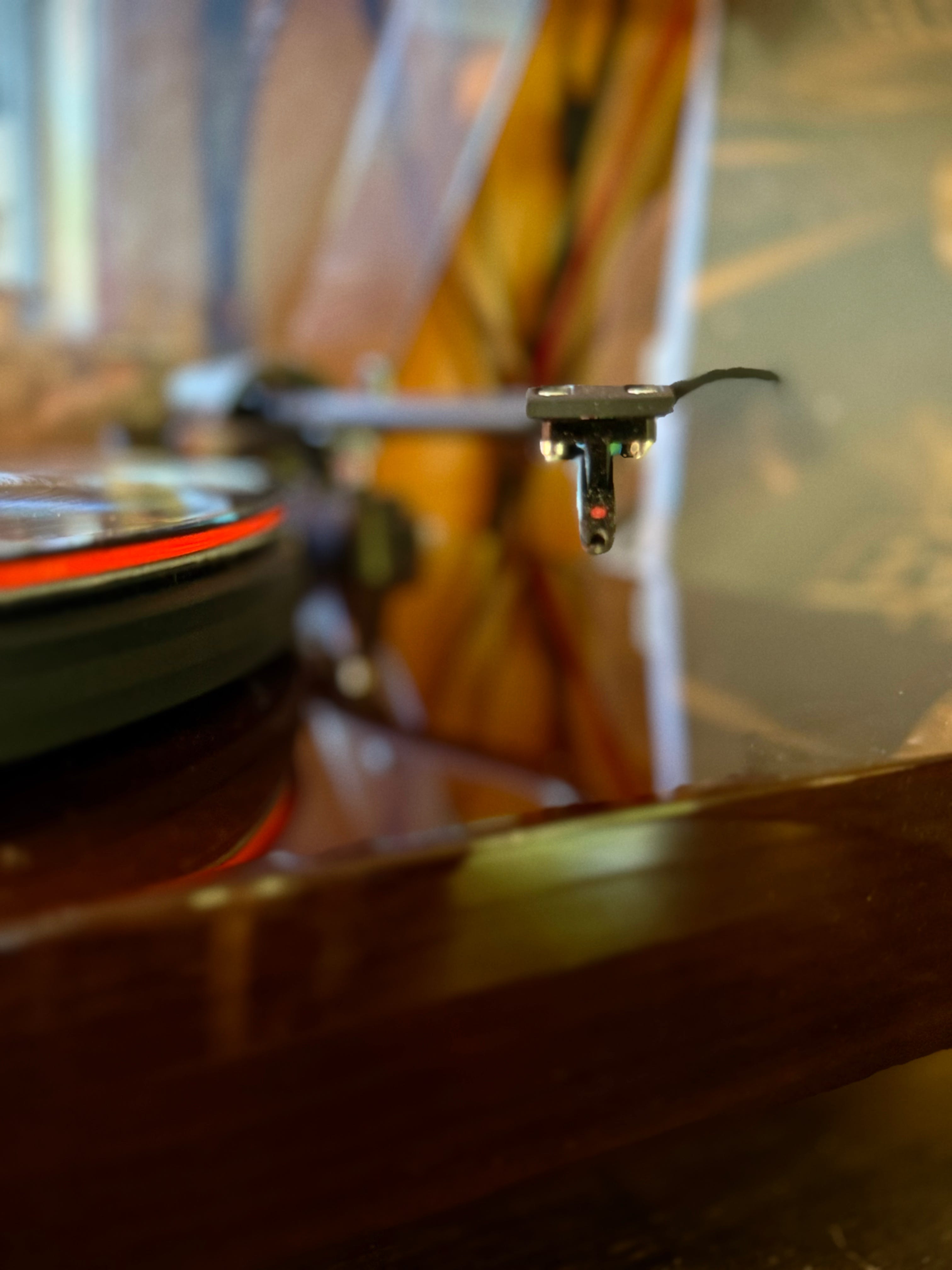
Is there a direct connection between quality and satisfaction? I think if one is to honestly engage in the vinyl versus CD conversation then this framing must be considered. Compact Discs reproduce sound at a higher fidelity than vinyl records – that fact is indisputable.
I’m the type of person who likes to gaze upon a sunset and still have my breath taken from me by the sublime natural beauty. I have an understanding of how the properties of light refraction impact the hues performing their symphony as colors blend into each other, the sun slipping beneath the horizon. That knowledge neither adds to nor subtracts from the wonder. The wonder simply is. I think vinyl records are of higher quality. Let’s get into it.
The vinyl versus CD debate is just the latest iteration of a conversation that has been happening since humans first tried to reconcile what they could measure with what they could feel. Nietzsche framed it as Dionysian versus Apollonian, Pirsig shifted things around slightly and developed the romantic versus classical. In our more common vernacular, we might think of art versus science — you and me, we see it as vinyl versus CD.
Pirsig’s argument probably serves us the best in this conversation, but this is a landscape we must tread through carefully. Pirsig wrote what is arguably one of the most important, accidentally philosophical, novels with Zen and the Art of Motorcycle Maintenance: An Inquiry into Values. Published in 1974 (coincidentally, the same year I was born), Pirsig’s novel was deeply polarizing, initially drawing extravagant praise from literary heavyweights before facing academic backlash and mixed reception from later readers — where have I heard this song before? Over the course of more than 400 pages Pirsig guides us through a conversation that focuses on the pursuit of quality through his alter ego, Phaedrus. Named after a figure in Plato’s dialogues, Phaedrus was a ruthlessly logical philosophy professor whose obsessive pursuit of the definition of quality drove him to insanity. As Phaedrus, Pirsig lost his mind — as the book’s author he found his way back.
Pirsig writes: “A person who sees Quality and feels it as he works is a person who cares. A person who cares about what he sees and does is a person who’s bound to have some characteristics of Quality.”
And here is where a motorcycle becomes relevant to our conversation. Pirsig’s novel unfolds as the story of two characters — one, our narrator who lovingly maintains his bike through a cross-country journey, the other, Phaedrus, who loses his mind chasing an idea. I don’t know about you, but before I drop the needle, I wipe down my record removing the dust, visually inspecting it for anything that could impede playback. The vinyl listener is the narrator. The audiophile chasing ever higher resolution digital formats is Phaedrus. Compact Discs are just one milepost on Phaedrus’ march toward insanity. If we continue down this road then we must consider high-resolution digital audio — demonstrably superior to the CD — thus leaving vinyl in the dust. The pursuit for quality, for perfection consumes us and we keep marching as technical advancement improves quality while ultimately subtracting from what got us here in the first place — the music.
We fool ourselves in the impossible pursuit of perfection — our humanity is found in those moments where we embrace those imperfections and more fully become them.
Pirsig eventually found his way to the ancient Greeks but may have arrived too late — had he encountered H.D.F. Kitto’s concept of aretē earlier, he might have saved himself considerable anguish. Pirsig can be forgiven for not coming to Kitto sooner — renown in academic circles does not always equate to cultural relevancy, a consideration we deep lovers of music are all too familiar with. Throbbing Gristle, anyone?
According to Kitto, aretē implies a respect for the wholeness or oneness of life, and a consequent dislike of specialization. It implies a contempt for efficiency... or rather a much higher idea of efficiency, an efficiency which exists not in one department of life but in life itself.
Compact discs are man in service of the machines chasing a zero-sum game of an ever-dwindling, quantifiable definition of quality where 1s and 0s capturing dynamic frequency ranges become the singular defining characteristic. Vinyl is machines in the service of man that in its own imperfect reproduction of a moment in the studio is quintessentially more human. Who doesn’t have flaws? We fool ourselves in the impossible pursuit of perfection — our humanity is found in those moments where we embrace those imperfections and more fully become them.
The house is impossibly quiet, only the hum of the HVAC system and the shuffling of my feet disrupt the silence. My feral monkeys are with the love of my life, their mother, on a road trip to Wyoming, so it’s just me. Flipping through my records, I land on my father’s copy of L.A. Woman by The Doors. Pulling it from the dust jacket, I can’t help but wince slightly as the light, surface scratch caused by my brother and me many, many years ago comes into focus — I know from experience it won’t affect the record but it’s a reminder. I wipe the record down, slip it onto the turntable and drop the needle. The crack and pop, even after the deep cleaning, fill the speakers before ‘The Changeling’ breaks on through. I know I could sit down at my computer, open Amazon or something similar and tomorrow have a brand-new CD of this recording. Not a doubt in my mind the quality would be better but as I slip into my chair and let the music surround me, I am deeply satisfied.