

Many moons ago while living in San Francisco’s Mission District along Valencia Street, I was sitting outside on the fire escape trying to figure out what I was going to do next. My trusty GMC Jimmy had been completely ransacked, stripped and was now undrivable – I needed something and I needed it fast.
I happened to live across the street from one of those buy-here, pay-here lots and as I looked up, my eyes fixed on the $6,000 price tag.
“I can afford that,” I thought to myself as I climbed back through the window with the notion of crossing the street to investigate further.
I won’t bore you with the details, but a few hours later I was driving a mid 90’s Saturn SL2 and calling the local public radio station to claim the Jimmy.
And then it happened.
Driving around The City, I started noticing Saturns everywhere. And I mean everywhere. They filled the parking lot of the tech company I worked for at the time, they were on the 280 as I made my way home and driving up and down Mission Street I couldn’t help but notice how many caught my attention.
Science has a name for this, the Baader-Meinhof phenomenon, also known as the frequency illusion. No, there weren’t suddenly more Saturns on the road but now my brain was flagging that car as relevant, and each additional sighting reinforced this notion.
That brings us to Welsh born artist Ren Eryn Gill. Lying in my hotel room in Spokane following a long, two-week fire assignment, I was checking out his latest release, Asylum, a collab with Connecticut rapper, Chris Webby. “Madhouse” opens the album and as I’ve come to expect from Ren – that is to say, have no expectations – I was immediately caught off guard by … what is this? Did I just wander into a 1930s vaudeville act? And as I lay there just really hearing the music, a thought interrupted the sounds – how is this cat not as big as Eminem?
Like a lot of folks in my United States circle, I came to Ren through the absolutely bat-shit bonkers, viral video “Hi Ren.” I can at least say I came to it before seeing any of the hundreds of therapist reaction videos to it, so I was at least allowed to fully bring all of my own baggage to it before hearing others. It moved me to tears … and I mean ugly, holy-shit I thought I’d dealt with that type of tears. Once I could think through the water works and the snot, I decided I was going to dig deep into this artist -- there’s no way this came out as a first shot out of the gate.
So I dug, I followed, I listened, and before too long my feed was full of reaction videos, clips of Ren out there busking, talking about his mental health struggles – suddenly everyone was talking about Ren.
But were they? Or were the algorithms that play such a large role in how we consume media these days doing their job serving me up a slew of Ren content. Were there really more Saturns on the road?
Offline, I would talk to my friends about the artist and they had no idea who he was, never heard of him. Even some of my more musically in touch folks were asking me who this white rapper I was blabbering on about was.
Really?
Ren’s second studio release Sick Boi, hit #1 on the UK charts in October 2023, his YouTube numbers are on par with artists with much greater industry support, 2.6 million subscribers and 592 million total views, while his Spotify numbers would make any indie artist jealous – 722.7 million streams across 74 tracks.
So why isn’t Ren more of a household name? There probably needs to be a conversation about UK charts vs. US charts, the way music in the UK is driven by a smaller set of tastemakers vs the wildly segmented, highly genre specific way music is presented in the States but we’ll save that for a later conversation.
I made the Eminem reference earlier, but that would put Ren into a box that’s more limiting than helpful. Is he an incredibly talented rapper, with insane lyrics? Yes, but that’s probably where the comparison stops.
As listeners and readers, we absolutely love to put artists into containers our brains can understand – if you like this, you should check this out. Which, by and large works, a lot of the time, as points of reference are useful for context. Until you stumble upon an artist like Ren. The more proper comparison might be Sting during his years as the lead singer of The Police – both because several of Ren’s tracks tend toward a similar reggae/Caribbean vibe found in Police releases like Synchronicity, and because Ren, like Sting, has steadfastly refused to be tied down to any one style. This is both a blessing and a curse.
Take “Hi Ren” as one small example – before we get to the meat of the song, our perception is smashed by a classical flamenco style arpeggio that completely knocks the ground out from under our feet. Whatever expectations you had going into this song, the flourish of notes immediately tells you to abandon them and just listen with every sense wide open.
Following the smashing success of Synchronicity, Sting made the choice to cash in his well-earned chips and experiment. The success of the album had granted him a wide berth to play around with styles and be the artist he felt he was. But it’s important to pull back the curtain and look at the infrastructure The Police had during this time.
Starting with the label, A&M. Label co-founder Jerry Moss once said The Police were “so different and exciting, unlike anything else on the radio, which made them perfect for A&M.” Miles Copeland, the band’s manager, delivered the label a demo tape including the song “Roxanne.” As the band was going into the studio, Moss was looking at lyric sheets, gobsmacked by what he was seeing, realizing he had a massive hit album on his hands before ever hearing the melody. So from the start, the label was behind this band in a way most new artists can only dream about. This is no small credit to the band’s talent, but it also speaks volumes to a label executive going all in based on instinct.
Then we get to the support infrastructure in place around this time frame. Synchronicity was released in 1983 at a time when radio markets around the world were geared toward album oriented rock and Top 40 formats controlled by a relatively small number of corporate owned stations. This was a moment when getting added to the right rotation on the right handful of stations meant you were nearly guaranteed exposure to millions of listeners who might never have heard you. During this period, radio stations lived and died by their ability to grab your attention with things you hadn’t previously sought out.
Early on, Copeland recognized the power of MTV and sensed the disruptive nature the format was going to have on the industry. The Police were the first band ever sponsored by MTV, leveraging the outlet to run promotional stunts as they flew contest winners to Montreal to see the band perform alongside Talking Heads, English Beat and Peter Tosh.
This is an infrastructure – thoroughly decimated in the years between – that simply doesn’t exist for an artist like Ren.
But even as the old system was being dismantled, a new system was slowly developing, evolving, working through the machinations on its way to being the dominant paradigm. We’re of course talking about social media and the rise of algorithmic discovery. While often maligned, and in many cases accurately so, it’s probably much more accurate to realize this new system exists in the grey – neither hero nor villain. For every artist lost in the ashes of the previous system, plenty have adapted to the new rules and found a level of success. Ren would be one such artist.
I mentioned earlier that there was no way “Hi Ren” was the first shot out the gate, and it doesn’t take much to realize how true that thought was. Born on March 29, 1990, in Bangor, Wales, at an early age, Ren taught himself to play guitar by slowing down his collection of Jimi Hendrix and John Frusciante records. By age 12 he was selling home-made beats, and then his whole life was shook when at 19 he lost one of his closest childhood friends, Joe Hughes, to suicide. That same year he entered Bath Spa University to study commercial music, forming a band with classmate Charlie Fowler. The two would busk around town, being discovered by producer Eric Appapoulay, who signed him to a development deal with Sony.
Then came the collapse.
At 25 years old, in what should have been his career takeoff, Ren gets violently ill, spending upwards of 23 hours a day in bed. Doctors misdiagnose him repeatedly: depression, bipolar disorder, chronic fatigue syndrome. The stress eventually triggers psychosis. Sony drops him. Years pass before he’s properly diagnosed with Lyme disease. Eventually Ren gets the treatment he needs via experimental stem-cell therapy in the United States. This doesn’t cure him, but it gives him enough energy to walk outside again as he starts busking along the streets of Brighton, and in 2016 he releases “Freckled Angels” as a tribute to Hughes.
One has to believe that artists like Ren will always find a way. Perhaps that’s an overly romantic view of the driven-artist trope, but it sure feels appropriate here. In 2017, Ren, alongside Romain Axisa, Gorran Kendall and later Glenn Chambers on drums, forms The Big Push. They’re rowdy, with a blues-inflected sound that takes the streets of Brighton by storm as they develop a loyal following. In 2021 the band hits the road for a sold-out series of shows around the United Kingdom, but Ren’s illness gets the better of him, and in 2022 the band splits up due to his ongoing health issues.
“To have gone from best friends playing out on the streets for fun, to one of the most well-known busking bands in the world in a few short years is something we are immensely proud of, and we will carry each adventure and experience it gave us forever,” the band said in a statement following their break-up.
Never let it be said the universe doesn’t have a sense of humor. The day after the band plays together for the last time, Ren releases “Hi Ren” to YouTube, and the gears in today’s hit-making machine begin to grind. I won’t belabor the point, but today’s music discovery is largely based on algorithmic recommendation and moments of virality. Virality is that flash-in-the-pan moment where suddenly everyone is using the same 30 seconds for their video. What happened to “Hi Ren” was much more slow-burn algorithmic discovery.
In its first month on the platform, “Hi Ren” hits the two million view threshold; by May 2023 it’s at 13 million views. Across YouTube, people are stumbling across this strange, dimly lit video with a young man in a wheelchair being pushed by a man wearing a pig head costume. It’s immediately disquieting, and the first few seconds do exactly what a great hook should – draw you in. The algorithm goes to work as reaction videos begin popping up, fellow musicians and therapists feeling compelled to weigh in on the video, analyzing the layers upon layers packed into the nine-minute affair. By mid-2024 the video grows past 30 million views, all without any major-label support, without any of the infrastructure in place that helped propel Sting and The Police to the international stars they became. As of August 2026, the video sits at 72 million views, the likelihood that number will continue to climb being high as viewer after viewer, disaffected kid after disaffected kid, adult after struggling adult sits down in front of their computer and the algorithm decides the moment they need to see this video is now.
It’s not an unpopular opinion to state that the algorithm is ruining modern culture. At this point, it’s probably the default opinion for most of us. Think piece after think piece is published citing degraded attention spans, the lack of intellectual fluency and other markers of a civilization in rapid decline. I’m not going to push back too hard on that – I tend to think there’s probably some merit in the words. But how much of this is also just old coots screaming at the kids to get off their lawn? The same thing was said about dime novels, comic books, radio, hell… about rock and roll – Satanic Panic anyone? If we didn’t exist in an age where discovery (not just music – BookTok is a thriving, healthy thing) was driven by the likes of YouTube and Spotify, would an artist like Ren even be possible?
The romantic in me desperately wants to believe that someone as genuinely talented as Ren absolutely would. That whatever the mechanism of the day, he would be discovered, he would be propelled forward until he was a household name. None of us can say for certain if that is true. What we can say for certain is that Ren is a product of his age. He used the tools available to him and will continue to do so. And why shouldn’t he, given the success he seems to have found? It’s given him a level of control he might not otherwise have. But let’s not wander into this with eyes wide shut – for every step Ren has taken, there’s been an associated cost. Each chosen path comes at a price. Ren gets to write his own rules, but the cost of that is he’s not as famous as he could be. So it’s not black and white, and I’ll never know if he made that decision consciously or if he, given everything he’s gone through, felt he had no other choice – and his decision almost certainly wouldn’t work out exactly the same way for another artist. They call it catching lightning in a bottle for a reason.
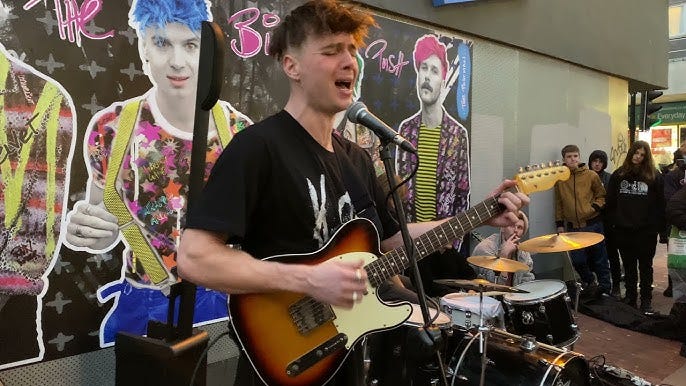
So Ren is having his moment. He’s at a point where his treatment protocols allow him to be back outside, performing – not cured, but functional. He’s doing the thing, his way. Along comes 2025, and Ren, alongside his former band, The Big Push, declares the Summer of Busk. They hit the streets of Brighton in a deliberate return to where they started. This wasn’t a one-off nostalgia stunt; it was a real, sustained run, guerrilla-style, culminating on September 6 in a three-hour beachfront set at Kings Road Arches, the same spot they’d busked seven years earlier. Back then, they played to a nearly empty pavement. This time, it was mobbed – fans leaning over the railings to watch.
And then something interesting happens at that performance – toward the show’s conclusion, Ren asks fans not to swarm him. He acknowledges some had traveled a long way to be there, but describes himself as “a neurodivergent mess” and says crowds trigger panic attacks for him. No A&R guy to drive him toward fan engagement, no PR person counseling against such statements – just Ren being Ren, deciding for himself what success means and how he shows up in it.
In cowboy movies, we know who the good guy is and who the bad guy is – white hat/black hat. Lost in that overly simplistic dichotomy is the grey hat, the world most of us actually live in – somewhere between the two, with no one thing truly falling one way or the other. Would Sting exist without the infrastructure in place at the time? Would Ren exist without algorithmic discovery? I don’t know. Nature abhors a vacuum, and when one system dies a new one will almost certainly rise to replace it. It’ll need time to mature, to go through the starts and stops of growing pains before reaching a maturity into something we just assume has always been there. There will be winners and there will be losers, alongside the multi-page essays on how best to game the new system. Wash, rinse, repeat.
Back in the early and mid 1990s, hunter green as a color was having a moment. My Saturn was hunter green, and alongside noticing all the Saturns on the road I couldn’t help but notice the Corollas, Malibus and other mid-size sedans colored hunter green. I also know that I’m seeing more Ren, and for that I’m grateful, whatever shade it appears. I’m glad I live in a world where I can dust off an old Police record and hear Sting’s voice, alongside a world where I can pop over to Ren’s website and order his latest release.
We also need to talk about Jesse Welles