Have you ever wondered what it would feel like to shift from fifth gear, humming along at 70 miles per hour, to first? You might survive the ensuing calamity assuming your head doesn’t punch through the windshield, your transmission almost certainly won’t. That was what it felt like moving from San Francisco to Galion, Ohio.
Don’t worry if you’ve never heard of Galion, even most folks from Ohio haven’t heard of it -- its only real distinction as a town is being one of two towns in the country whose name is a singularity. There is only one Galion, thank the gods. And yet, here I was having survived the chaotic downshift.
Survived is probably the best word. I was beaten and battered but I was still alive, left in a state of shock. A typical Friday night in The City involved walking a few blocks to the Justice League and catching some new band coming through town, followed by a trip to Amoeba Music the next morning searching for something that either reminded me of the band I’d just heard or an even deeper dive into last night’s offerings. The height of Galion entertainment was mostly a collection of cautionary tales as you looked in horror at the shell of a human clutching their cheap wine at the edge of whatever dive-bar you found yourself in, vowing to never become them.
It was another one of those Ohio nights. Bored, dissatisfied, questioning every life decision I’d made that resulted in me being here. The one true thing in my life at that moment laid out on his freshly laundered blanket spread out on the floor. Kerouac was all of a month old as I sat there next to him, guitar in hand, determined to finally learn how to play this thing. I set the guitar down, walked over to the computer seeking inspiration, something fresh, something my ears could rejoice in. Back in 2001, Amazon was still a spunky internet newcomer, squarely in the pantheon of good guys, so I flipped over to the site and started digging for new music, stopping every few minutes to check on little man; change a diaper, feed a bottle.
Something caught my attention – “Whatever Happened to My Rock and Roll” by Black Rebel Motorcycle Club (shit, that’s a mouthful), ok let me give this a try.
Hooked.
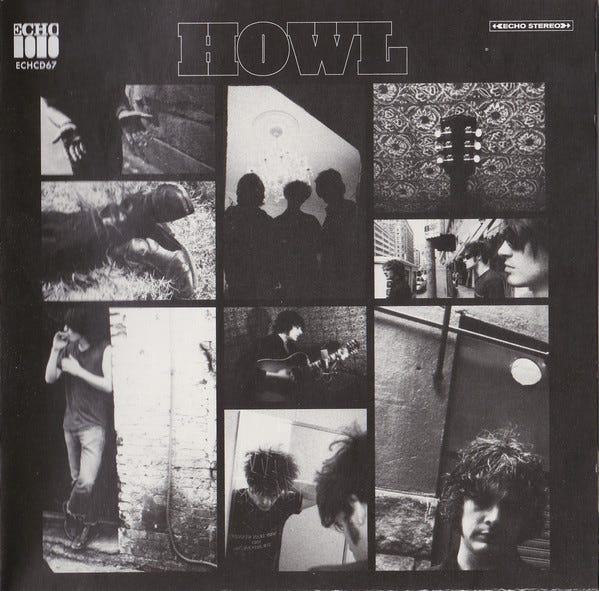
Thus began my love affair with B.R.M.C. as they became more commonly known, which brings us to the band’s third album, Howl, released in 2005. But hold on, we’re not there just yet.
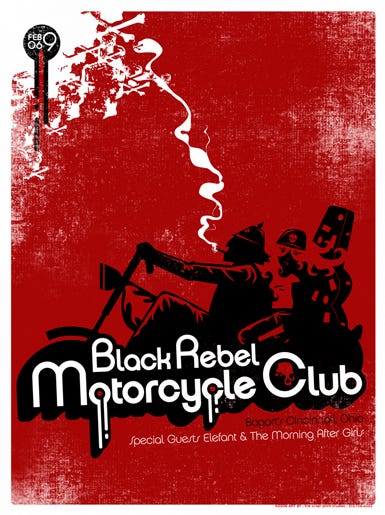
What must it have been like to be a new band in the late 1990s or early 2000s. Napster was slowly dismantling a distribution system that put the album first, record stores were rapidly circling the drain, and record labels, already feeling the pinch, were pulling back on development – you delivered now or you were gone. Into that fray stepped Robert Levon Been (bass, vocals), Peter Hayes (guitar, vocals), and Nick Jago (drums) as Black Rebel Motorcycle Club. Their self-titled debut was released on Virgin Records in April of 2001. While it didn’t chart in the United States, it reached #25 in the UK and was certified gold. Along came Take Them On, On Your Own, again on Virgin Records, peaking on the US charts at #47 and going gold in the UK, topping out on the charts at #3.
These first two records were a smash-up of British shoegaze and post-punk in the vein of Jesus and Mary Chain, Love and Rockets and the Stone Roses, while adding a healthy dose of classic rock’s swagger with nods to the Rolling Stones, T-Rex and the Velvet Underground. Black Rebel Motorcycle Club found themselves in pretty good company at the time as bands like The White Stripes, The Dandy Warhols and Interpol were dipping their toes in the same waters, each with their own flavor to the sound.
But B.R.M.C. had headwinds working against them that had nothing to do with the music. When was the last time you heard of a label dropping a band who had a #3 album in the UK? By 2003, labels were in full panic mode, tightening budgets, getting more conservative about who they’d sign and how long they’d tolerate a band that wasn’t immediately profitable. Add to the mix an unstable relationship with drummer Jago, later revealed to be substance abuse problems, and you’ve got a band suddenly imploding without a record label to backstop them.
During the 2003 NME awards, Jago’s unraveling became public when he stood on stage accepting an award and was silent for a full nine minutes. Things only spiraled from there after a fight with Hayes following a gig in Scotland that saw Jago pushed out of the band. So no drummer, no label and no guarantee anyone was listening, and Been and Hayes decided to push forward anyway, entering the studio with a collection of material they’d been messing around with backstage and in their off-time.
In a 2025 interview marking Howl’s 20th anniversary, Been told NME: “We were dropped from our label after our second album so Howl was like this Hail Mary to see if anyone gave a shit anymore… and every label passed on it. RCA only signed us with the stipulation that they’d put out a small amount in boutique stores if we promised to put out a rock record next.”
It felt like a Hail Mary. When I first ripped off the cellophane, cracked open the case, popped the disc in the player, the music that filled my house was a complete departure from anything the band had produced before. Gone was the Jesus and Mary Chain fuzz I loved so much, the driving rhythms and frenetic energy the previous two albums were filled with. In their place was stripped down arrangements, tones and sounds that harkened back to American roots; soul, blues, acoustic guitars, hand clapping beats and songs languidly stretching themselves out across nearly an hour.
I shelved it. There was so much on my plate both musically and personally that I didn’t have time for something that didn’t hit immediately. And it stayed that way for a few weeks as the album slowly drifted to the edge of my consciousness.
Somewhere between Galion and Boone County, West Virginia, on my way to see a rare performance by Jesco White and Hank III, I was flipping through the book of CDs in the seat next to me. Howl was in there - I’d absently popped it into the book at some point though I honestly couldn’t tell you why or when.
“Meh, why not,” I thought to myself as I pulled it from the book and slid it into the car’s player. Maybe I’d changed enough in the in-between weeks, maybe the waning sun and the fog-drenched hills were working some dark magic, who knows, but suddenly the album just clicked.
During my high school years, I was deeply involved in choir, drama and other musical arts. As a member of the men’s quartet, we would often slip off before a performance to one of the cavernous stairwells around the school looking for a fullness of sound that exists in such places. Hit play on Howl and the album’s first track, “Shuffle Your Feet,” feels like a band that slipped off to find a stairwell, just having fun as the voices harmonize before working themselves into a stomp-clap rhythm that ushers in a bluesy acoustic guitar.
In a 2025 interview with The Arts Fuse, Been elaborated on the philosophy driving the album’s creation: “We didn’t really know what we were doing when we started. We had a lot of the songs already written probably even before our first album ever came out. We had a lot of these rootsy songs that we would just have fun playing backstage or on tour buses with acoustic instruments. They didn’t really fit with the sound of the band that the public had become familiar with, so we first started recording the songs separately rather than trying to blend them in or put them through distortion pedals to make them into rock songs... We started recording one after another, and what started as a throwaway acoustic album kept growing.”
As if to put an exclamation point on that thought in response to fan backlash upon initial release, Hayes summed it up perfectly – “We kept telling you guys we loved Johnny Cash, but no one would listen.”
About halfway through the record, we get to the album’s emotional center. “Promise” opens with a lilting piano sequence, an instrument Been had to learn specifically for this recording. “I’ll comfort you, I’ll stay with you, it’s a promise not forgotten.” For a band in the middle of such internal turmoil, what must these lyrics have meant? Were they projecting out to Jago, who’d entered rehab and makes an appearance on this record specifically for this song? Like any truly great song, the writer’s meaning is somewhat secondary in that its original point is shrouded in just enough mystery that we as the listener can layer onto it whatever we like, making it ours. The best songs don’t give you answers but instead guide you to answers that were inside you all along.
Around Charleston, West Virginia, I eased off the main highway onto a series of state routes and winding back roads on my way to the show. West Virginia and Appalachia is as much lore as it is real, and so it felt appropriate that “Restless Sinner” cracked to life as I made this portion of my journey. Drenched in deep Mississippi blues, a slight menace sits just below the surface like a reckoning. It can’t be an accident that “Restless Sinner” is followed on the album by “Gospel Song,” tracing an arc of the sinner whooping it up on Saturday night only to find himself in a pew on Sunday morning, coming to terms with his own soul alongside the hangover.
Some twenty years on, and this album, one I almost tossed on first listen, stands as one of my favorite records of all time. And here we get to the nut of a deeply held philosophy – music finds us when we’re ready and not a moment sooner. Maybe Howl needed a proper setting, a West Virginia road trip, hours alone as fog-drenched hillsides worked their magic, setting a stage in my mind’s eye that let me truly hear it. I hope I never forget that: moment, place, time and magic all have a role to play in my musical journey, and what didn’t land yesterday might just find a home today.